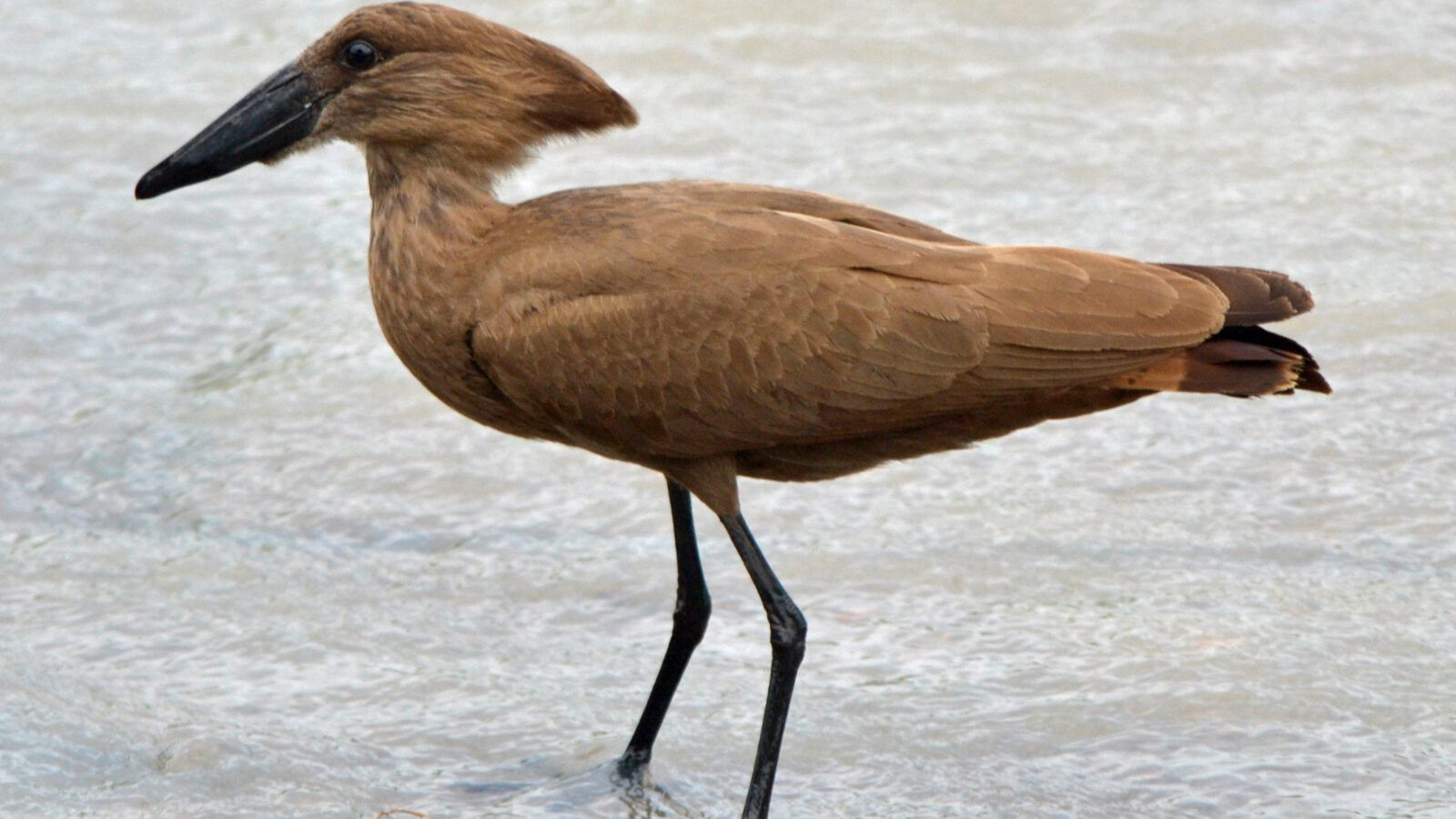
Photo: Voidoffrogs / CC0 (Wikimedia Commons)
Hamerkop
Scopus umbretta
Hamerkop (Scopus umbretta) — Herons, Pelicans & Ibises of Africa.
Found across 4 guides in our atlas — open any for the full checklist, photos and what's around right now.
The Hamerkop (Scopus umbretta) is a member of the Scopidae family found in Africa. Adults weigh 472 g. The IUCN Red List lists it as Least Concern.
Conservation status
IUCN Red List (opens in a new tab)Widespread and abundant — not currently at risk.
Where it fits
- Class Aves
- Order Pelecaniformes
- Family Scopidae Hamerkop
- Genus Scopus
- Species umbretta
Quick facts
- Weight
- 472 g
- Diet
- Omnivores
- Family
- Scopidae
- Order
- Pelecaniformes
- Habitat
- Wetland, lake & coast
Biology & behaviour
Diet
The Hamerkop is a omnivore — it takes a broad, omnivorous diet of both plant and animal foods.
Behaviour
A bird of wetlands, it forages mainly on the ground.
Migration
The Hamerkop is partially migratory: some populations move with the seasons while others stay resident year-round.
The Hamerkop (Scopus umbretta) is a species of bird in the Scopidae family, part of the order Pelecaniformes. It is found across Africa. Its distribution covers AF also sw Arabian Pen.
It is a large bird. Adults weighs around 472 g, with a wing length of about 29.3 cm and a tail of around 15.4 cm.
The IUCN Red List currently assesses it as Least Concern. That category covers species that remain widespread and reasonably abundant in the wild.
The species has a mapped global range of roughly 19.9 million km² — a very large global range.
Songs & calls
Frequently asked questions
How big is the Hamerkop?
The Hamerkop is a large bird that weighs around 472 g.
Where does the Hamerkop live?
The Hamerkop is found across Africa with a range covering AF also sw Arabian Pen, where it is associated with wetlands, lakes and other open water.
What family does the Hamerkop belong to?
The Hamerkop (Scopus umbretta) belongs to the Scopidae family, in the order Pelecaniformes.
What does the Hamerkop eat?
The Hamerkop is a omnivore — it takes a broad, omnivorous diet of both plant and animal foods.
Does the Hamerkop migrate?
The Hamerkop is partially migratory: some populations move with the seasons while others stay resident year-round.
Is the Hamerkop endangered?
The IUCN Red List currently assesses it as Least Concern That category covers species that remain widespread and reasonably abundant in the wild.
What sound does the Hamerkop make?
1 real field recording of the Hamerkop — including its call — can be played in the Songs & calls section on this page, credited to the recordist who captured it.
How large is the Hamerkop's range?
The Hamerkop has a mapped global range of about 19.9 million km².
Conservation
Every bird benefits from bird-safe windows, native plants, and keeping cats indoors. Small changes at home add up to real protection.
Explore more birds
More in Herons, Pelicans & Ibises
 Least Concern
 Least Concern
 Least Concern
 Near Threatened
 Least Concern
 Least Concern