
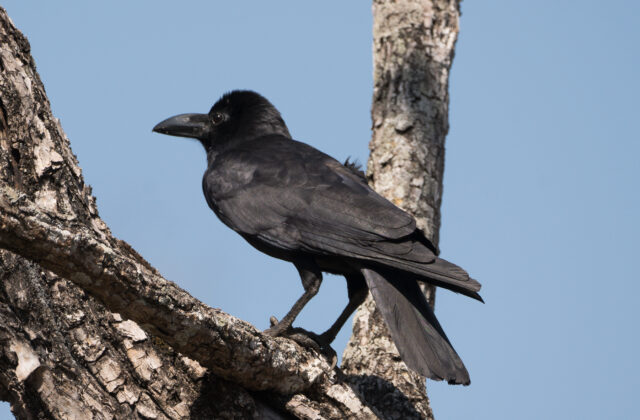
Photo: andrewlai530 / CC BY 4.0 (Wikimedia Commons)
Collared Crow
Corvus torquatus
Collared Crow (Corvus torquatus) — Crows, Jays & Magpies of Europe & Northern Asia.
The Collared Crow (Corvus torquatus) is a member of the Corvidae family found in Europe & Northern Asia and South & Southeast Asia.
Where it fits
- Class Aves
- Order Passeriformes
- Family Corvidae Crows, Jays
- Genus Corvus
- Species torquatus
Where it lives
Eastern, central China, northern Vietnam
Quick facts
- Family
- Corvidae
- Order
- Passeriformes
Biology & behaviour
The Collared Crow (Corvus torquatus) belongs to the Corvidae family of the order Passeriformes. It is found across Europe & Northern Asia and South & Southeast Asia. Its distribution covers PAL, OR e, c China, n Vietnam.
Its mapped global range covers an estimated 2.1 million km².
Songs & calls
Frequently asked questions
Where does the Collared Crow live?
The Collared Crow is found across Europe & Northern Asia and South & Southeast Asia with a range covering PAL, OR e, c China, n Vietnam.
What family does the Collared Crow belong to?
The Collared Crow (Corvus torquatus) belongs to the Corvidae family, in the order Passeriformes.
What sound does the Collared Crow make?
1 real field recording of the Collared Crow — including its call — can be played in the Songs & calls section on this page, credited to the recordist who captured it.
How large is the Collared Crow's range?
The Collared Crow has a mapped global range of about 2.1 million km².
Conservation
Every bird benefits from bird-safe windows, native plants, and keeping cats indoors. Small changes at home add up to real protection.
Explore more birds
More in Corvidae
 Least Concern
 Least Concern
 Critically Endangered
 Least Concern
 Least Concern
 Vulnerable
More in Corvids
 Least Concern
 Endangered
 Least Concern
 Not Evaluated
 Least Concern
 Least Concern
Guides for this bird
Best Feeders for Jays & Larger Garden Birds
How to choose a feeder for jays and other big, bold garden birds — the styles that suit peanuts and larger food, and how to keep them from crowding your small-bird feeders. A decision framework with the species in the Birbs encyclopedia.