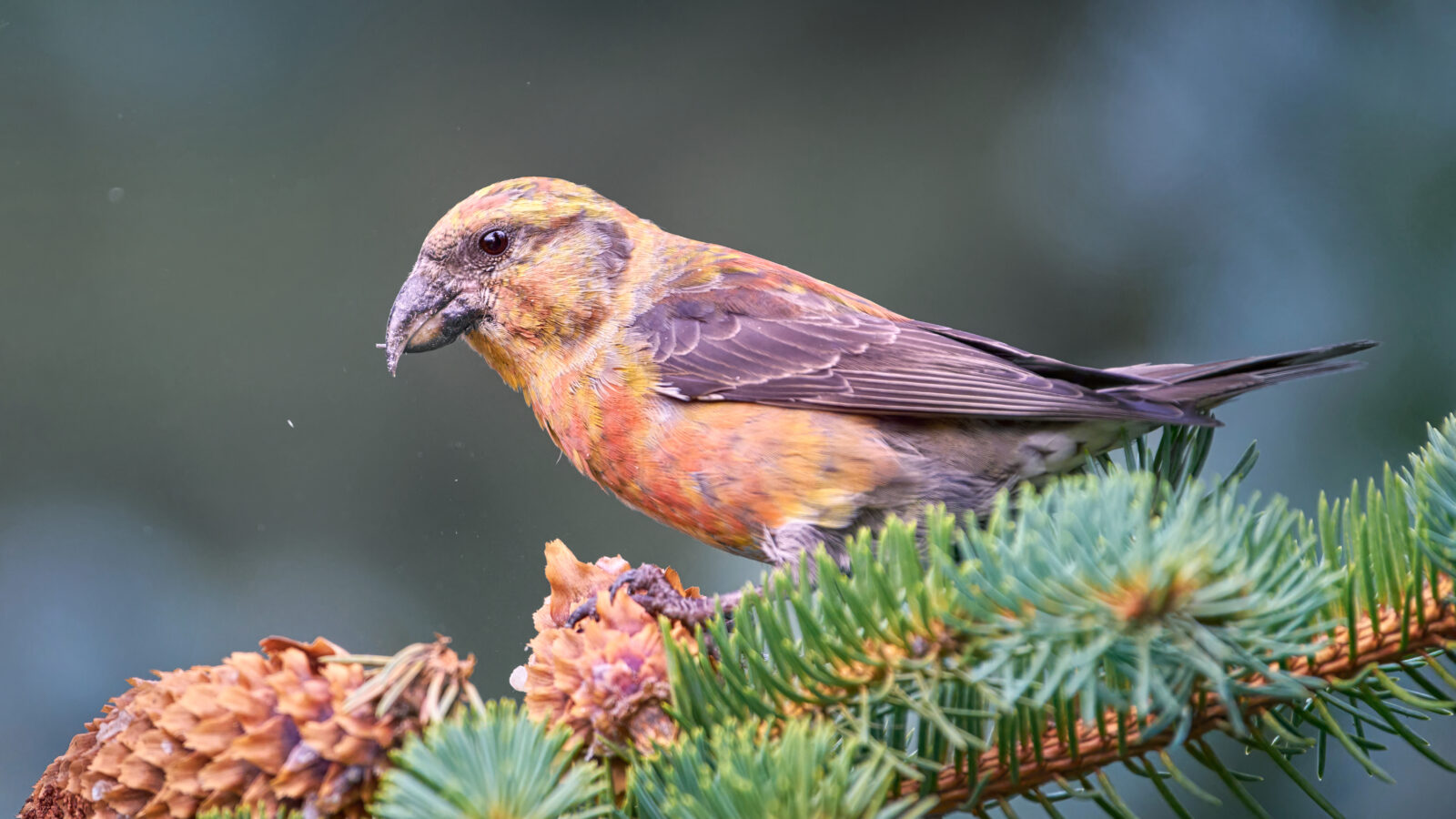
Photo: Andrey Gulivanov / CC BY 2.0 (Wikimedia Commons)
Red Crossbill
Loxia curvirostra
Red Crossbill (Loxia curvirostra) — Songbirds & Perching Birds of Europe & Northern Asia.
Found across 19 guides in our atlas — open any for the full checklist, photos and what's around right now.
The Red Crossbill (Loxia curvirostra) is a member of the Fringillidae family found in Central America & Caribbean, Europe & Northern Asia and North America. Adults weigh 38.3 g. The IUCN Red List lists it as Least Concern.
Conservation status
IUCN Red List (opens in a new tab)Widespread and abundant — not currently at risk.
Where it fits
- Class Aves
- Order Passeriformes
- Family Fringillidae Finches, Euphonias
- Genus Loxia
- Species curvirostra
Where it lives
Subarctic to subtropical Holarctic conifer forest: British Isles, Scandinavia (except far northern) east across Russia to Sea of Okhotsk, Sakhalin and southern Kuril Is. (southeastern Russia), Hokkaido to central Honshu (northern, central Japan), northern Korean Pen., in south through Iberian Pen., Morocco to Tunisia (northwestern, north-central Africa), east through Mediterranean, Turkey, Caucasus, Altai of eastern Kyrgyzstan, eastern Kazakhstan, northwestern Xinjiang (northwestern China), southern, central Mongolia to Heilongjiang and Hebei (northeastern China); disjunctly west-central to eastern Himalayas, southeastern Tibet, Qinghai and Gansu to northwestern Yunnan; southern Vietnam; Luzon (northern Philippines); southeastern Alaska east to Newfoundland (northeastern Canada), south to northern Baja California (northwestern Mexico), Rocky and Appalachian mts., south through Nicaragua
Quick facts
- Weight
- 38.3 g
- Diet
- Seed-eaters
- Family
- Fringillidae
- Order
- Passeriformes
- Habitat
- Woodland
How to identify
Similar birds
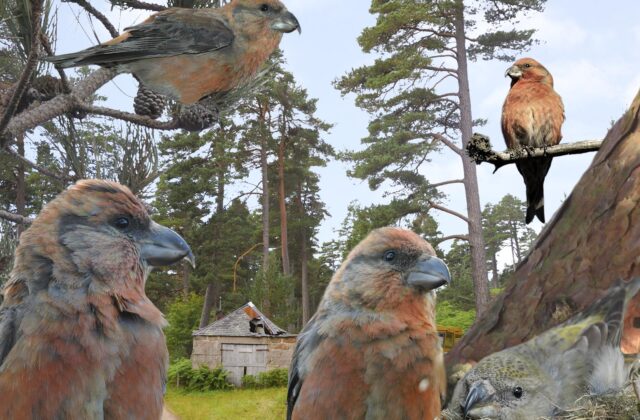 Least Concern
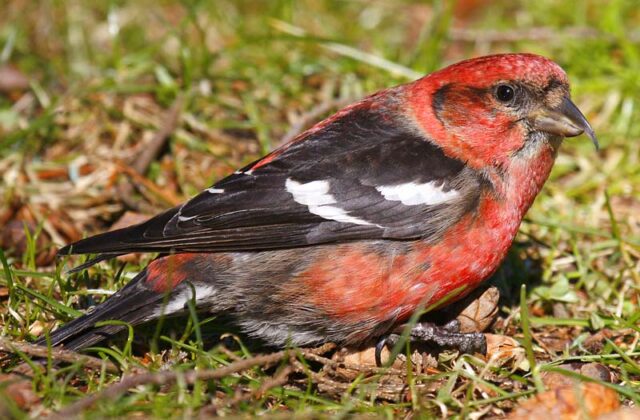 Least Concern
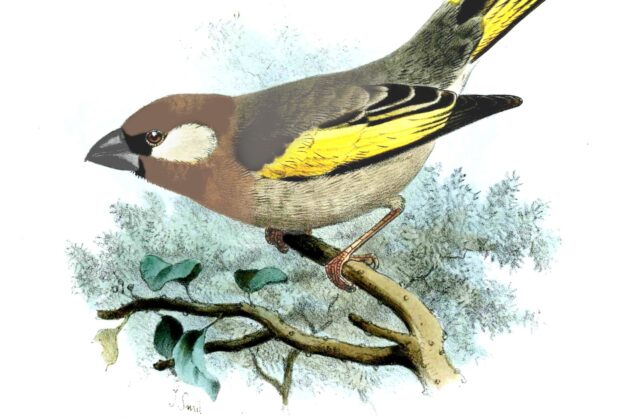 Near Threatened
Biology & behaviour
Diet
The Red Crossbill is a granivore — it feeds mainly on seeds and grain.
Behaviour
A bird of dense forest, it spends much of its time perched in trees and shrubs.
Migration
The Red Crossbill is partially migratory: some populations move with the seasons while others stay resident year-round.
The Red Crossbill (Loxia curvirostra) is a member of the Fringillidae family, within the order Passeriformes. It occurs naturally across Central America & Caribbean, Europe & Northern Asia and North America. Its distribution covers PAL, OR, NA, MA subarctic to subtropical Holarctic conifer forest: British Isles, Scandinavia (except far n) e across Russia to Sea of Okhotsk, Sakhalin and s Kuril Is. (se Russia), Hokkaido to c Honshu (n, c Japan), n Korean Pen., in s through Iberian Pen., Morocco to Tunisia (nw, nc Africa), e through Mediterranean, Turkey, Caucasus, Altai of e Kyrgyzstan, e Kazakhstan, nw Xinjiang (nw China), s, c Mongolia to Heilongjiang and Hebei (ne China); disjunctly wc to e Himalayas, se Tibet, Qinghai and Gansu to nw Yunnan; s Vietnam; Luzon (n Philippines); se Alaska e to Newfoundland (ne Canada), s to n Baja California (nw Mexico), Rocky and Appalachian mts., s through Nicaragua.
It is a small bird. Adults weighs around 38.3 g, with a wing length of about 9.6 cm and a tail of around 5.7 cm.
The IUCN Red List currently assesses it as Least Concern. That category covers species that remain widespread and reasonably abundant in the wild.
Its mapped global range covers an estimated 22.7 million km² — a very large global range.
Songs & calls
Frequently asked questions
How big is the Red Crossbill?
The Red Crossbill is a small bird that weighs around 38.3 g.
Where does the Red Crossbill live?
The Red Crossbill is found across Central America & Caribbean, Europe & Northern Asia and North America with a range covering PAL, OR, NA, MA subarctic to subtropical Holarctic conifer forest: British Isles, Scandinavia (except far n) e across Russia to Sea of Okhotsk, Sakhalin and s Kuril Is. (se Russia), Hokkaido to c Honshu (n, c Japan), n Korean Pen., in s through Iberian Pen., Morocco to Tunisia (nw, nc Africa), e through Mediterranean, Turkey, Caucasus, Altai of e Kyrgyzstan, e Kazakhstan, nw Xinjiang (nw China), s, c Mongolia to Heilongjiang and Hebei (ne China); disjunctly wc to e Himalayas, se Tibet, Qinghai and Gansu to nw Yunnan; s Vietnam; Luzon (n Philippines); se Alaska e to Newfoundland (ne Canada), s to n Baja California (nw Mexico), Rocky and Appalachian mts., s through Nicaragua, where it favours woodland, forest and well-treed country.
What family does the Red Crossbill belong to?
The Red Crossbill (Loxia curvirostra) belongs to the Fringillidae family, in the order Passeriformes.
What does the Red Crossbill eat?
The Red Crossbill is a granivore — it feeds mainly on seeds and grain.
Does the Red Crossbill migrate?
The Red Crossbill is partially migratory: some populations move with the seasons while others stay resident year-round.
Is the Red Crossbill endangered?
The IUCN Red List currently assesses it as Least Concern That category covers species that remain widespread and reasonably abundant in the wild.
What sound does the Red Crossbill make?
1 real field recording of the Red Crossbill — including its flight call — can be played in the Songs & calls section on this page, credited to the recordist who captured it.
How large is the Red Crossbill's range?
The Red Crossbill has a mapped global range of about 22.7 million km².
Conservation
Every bird benefits from bird-safe windows, native plants, and keeping cats indoors. Small changes at home add up to real protection.
Explore more birds
More in Fringillidae
 Not Evaluated
 Least Concern
 Vulnerable
 Near Threatened
 Least Concern
 Least Concern
More in Songbirds
 Vulnerable
 Least Concern
 Least Concern
 Least Concern
 Least Concern
 Least Concern
Guides for this bird
Best Bird Feeders for Garden Songbirds
How to choose a bird feeder for garden songbirds — the feeder styles compared, the seed they prefer, where to hang it, and how to keep birds safe. A decision framework grounded in real data, with no mystery picks.
Meet the Fringillidae
A field guide to the Fringillidae family — 238 species in the Birbs encyclopedia, with the best-known members to start with.