American Crow vs Northern Raven: How to Tell Them Apart
How to tell a American Crow from a Northern Raven — size, range, family and status compared side by side, with links to each bird’s full ID guide.
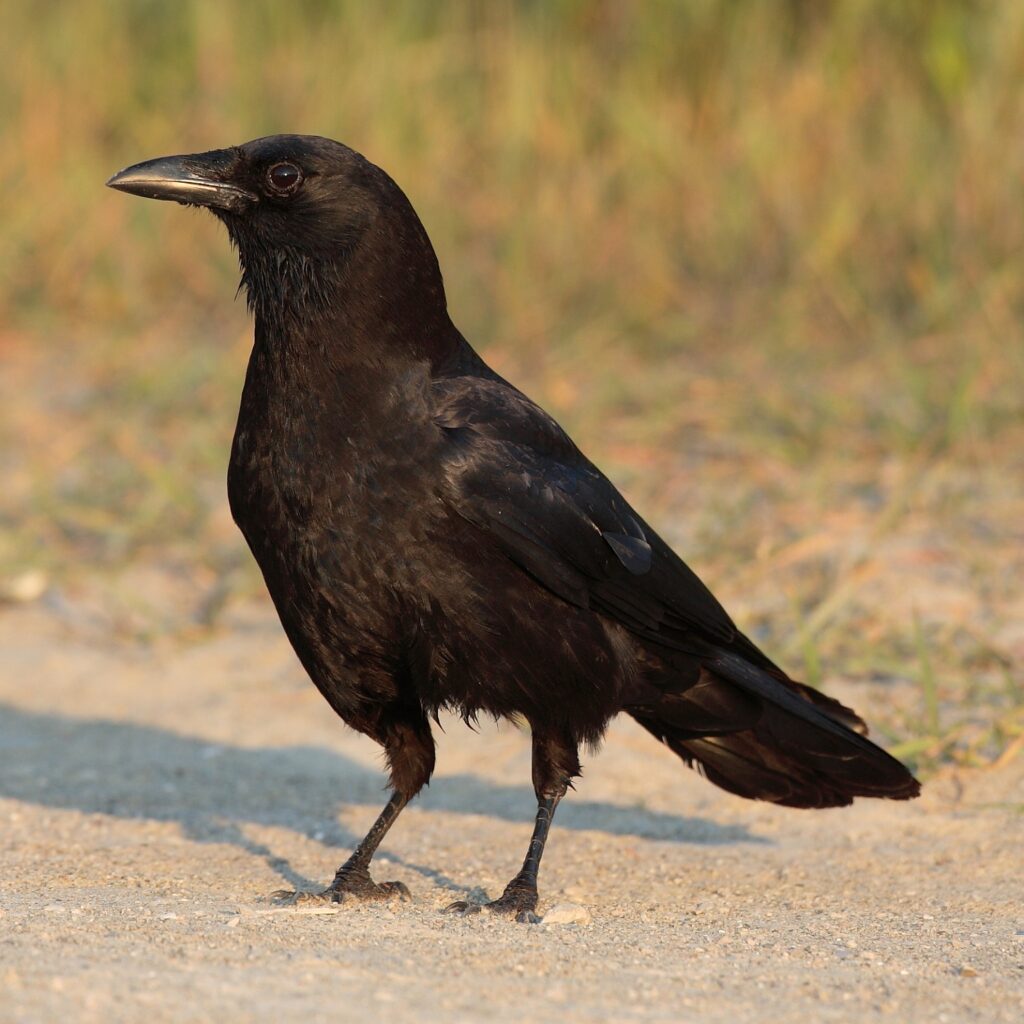
The quickest tell is size: the Northern Raven is noticeably heavier (around 928 g) than the American Crow (around 449 g). Here is how the two compare across every fact we track.
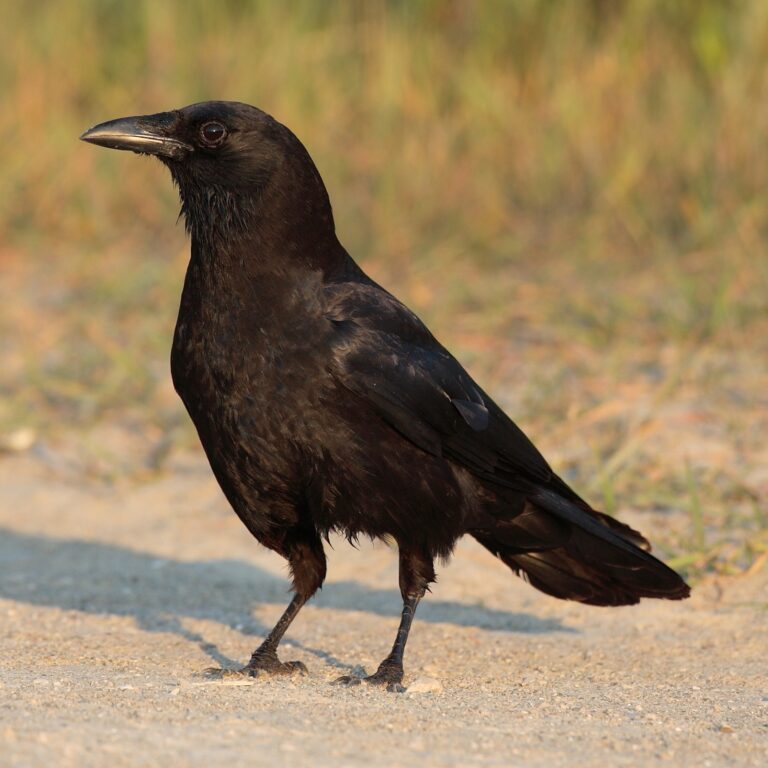 American CrowCorvus brachyrhynchos
 Northern RavenCorvus corax
See the American Crow → See the Northern Raven →
How to tell them apart in the field
Voice and tail settle it fastest: American Crow gives the familiar clear "caw-caw," while Common Raven gives a deep, hollow, gurgling croak; in flight the crow's tail fans open evenly (rounded/squared tip) while the raven's is a distinct wedge with longer central feathers. The raven is also strikingly bigger — close to Red-tailed Hawk size — with a heavier bill and shaggy throat hackles.
| Field mark | American Crow | Northern Raven |
|---|---|---|
| Voice | Clear, open 'caw! caw!' — never a true croak; even its harsh scolds stay higher and flatter | Deep, hollow, gurgling croak — 'gronk-gronk' — audible for more than a mile, plus low rattles and knocking sounds |
| Tail shape (flight) | Tail fans open evenly, feathers all about the same length — a rounded or squared-off tip | Wedge- or diamond-shaped tail — central feathers clearly longer, tapering toward a point |
| Size | About two-thirds the raven's size — roughly 17 in long with a wingspan up to about 39 in | Nearly Red-tailed Hawk sized — around 24 in long with a wingspan up to about 46 in |
| Flight style | Steady, rowing wingbeats; rarely glides more than a moment and almost never soars | Soars and glides on thermals on long, narrower wings with fingered tips; performs rolls and tumbling aerobatics |
| Bill | Smaller, straighter bill in proportion to the head | Massive, thick bill with a curved upper ridge and long shaggy nasal bristles over the base |
| Throat and company | Smooth, sleek throat; typically in family groups or larger flocks | Shaggy throat hackles that flare when calling; most often travels in pairs |
Telling females & immatures apart: Sexes are identical in both species, so the trap is age, not sex: fledgling and first-summer birds scramble the voice tell. Begging juvenile crows sound hoarse and nasal — nothing like the adult caw — and young ravens are higher-pitched and less resonant for their first few months, so a "weird-sounding crow" or "small-sounding raven" is common in late summer. For young birds fall back on tail shape and bill size, which hold at every age.
By voice: American Crow: a clear "caw! caw! caw!". Common Raven: a deep, hollow, gurgling croak — "gronk-gronk" or "cr-r-ruck" — carrying more than a mile, plus dry rattles and a wooden knocking. This is THE tell for the pair: no crow call has the raven's low, resonant croak.
Side by side
For plumage, calls and the finer field marks, open each bird’s full profile — every one has photos, sounds and ID notes.
More bird showdowns
- American Goldfinch vs Pine Siskin: How to Tell Them Apart
- Bald Eagle vs Golden Eagle: How to Tell Them Apart
- Barn Swallow vs Tree Swallow: How to Tell Them Apart
- Belted Kingfisher vs Great Blue Heron: How to Tell Them Apart
- Black Vulture vs Turkey Vulture: How to Tell Them Apart
- Black-capped Chickadee vs Carolina Chickadee: How to Tell Them Apart
Figures are the data we hold for each species (body weight, size class, family, range and conservation status); they describe typical individuals and can vary. Plumage and voice details live on each bird’s profile.
Frequently asked questions
Is the Northern Raven bigger than the American Crow?
Yes — the Northern Raven is heavier, around 928 g, versus about 449 g for the American Crow.
Are the American Crow and the Northern Raven related?
Yes — both are Corvidae, so they are close relatives.
Do the American Crow and the Northern Raven live in the same places?
Range: their ranges overlap in North America.