Black-capped Chickadee vs Carolina Chickadee: How to Tell Them Apart
How to tell a Black-capped Chickadee from a Carolina Chickadee — size, range, family and status compared side by side, with links to each bird’s full ID guide.
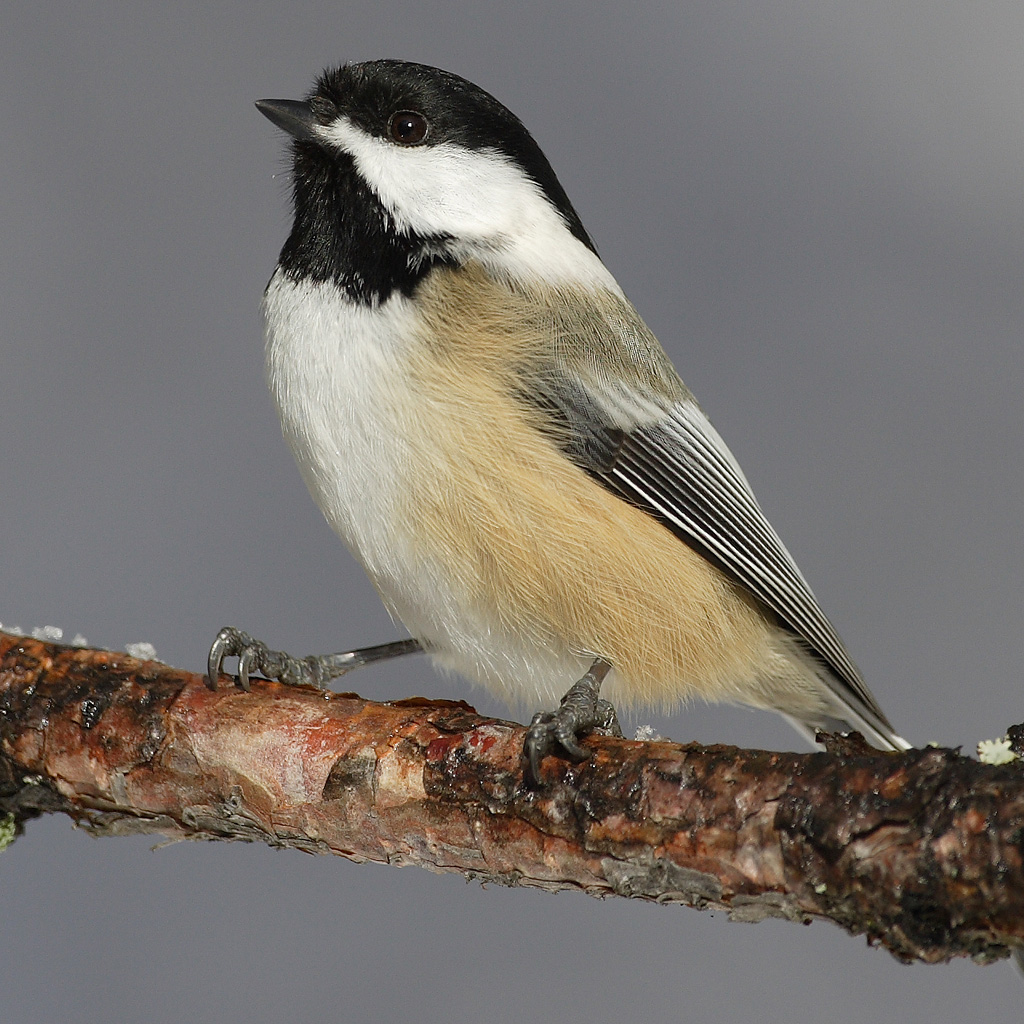
The Black-capped Chickadee and the Carolina Chickadee are easy to mix up. Here is how the two compare across every fact we track — size, range, family and status.
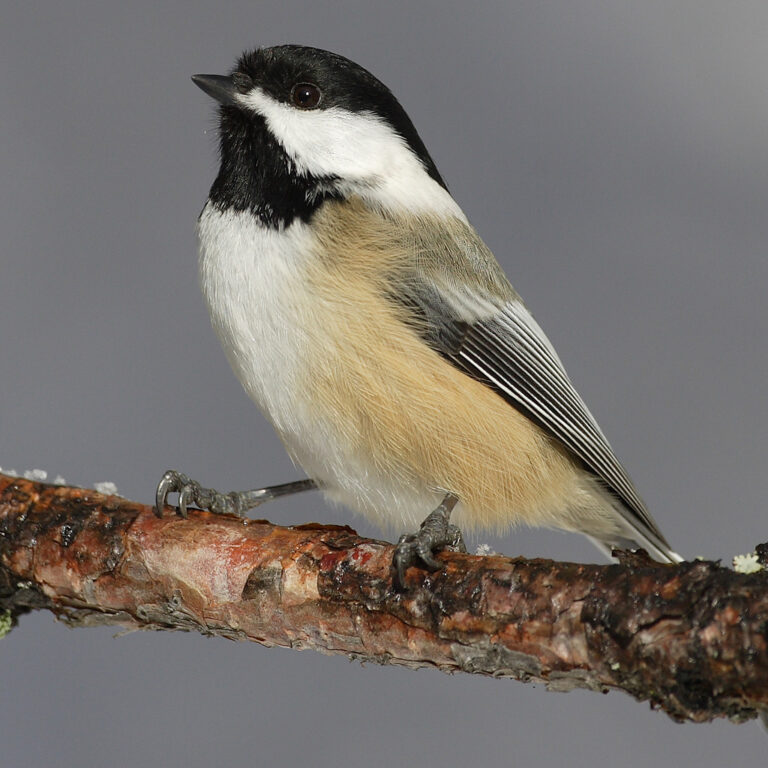 Black-capped ChickadeePoecile atricapillus
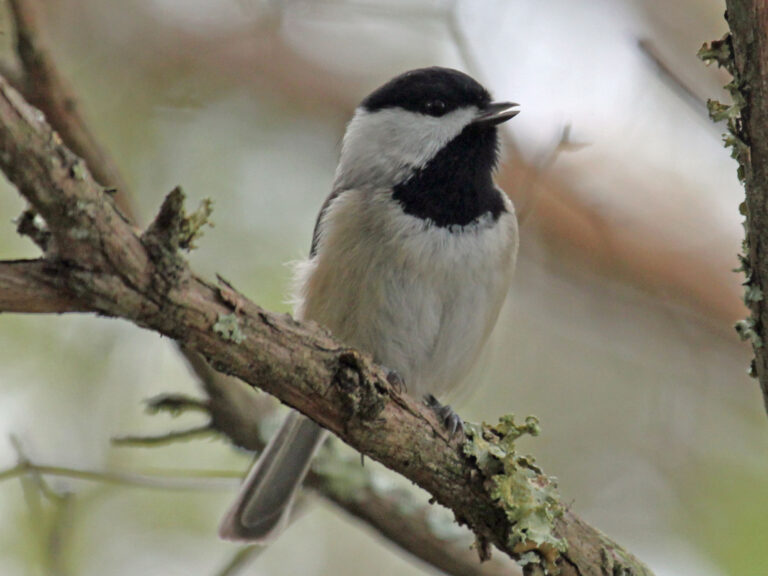 Carolina ChickadeePoecile carolinensis
See the Black-capped Chickadee → See the Carolina Chickadee →
How to tell them apart in the field
Best split by voice; visually, Black-capped shows bold white wing-panel (white-edged coverts/secondaries) and a ragged/blobby bib edge, while Carolina shows little wing white and a neat, straight bib line.
| Field mark | Black-capped Chickadee | Carolina Chickadee |
|---|---|---|
| Wing edging | Bold white edgings on greater coverts and secondaries form an obvious pale panel/'hockey-stick' on the folded gray wing | Little white wing-edging; wing looks plainer and more uniform silvery-gray |
| Black bib edge | Lower edge of the black bib is ragged/blobby and uneven (a 'double-rounded' bulge on each side) | Bib is smaller with a cleaner, straighter, well-defined lower border (a neat triangle) |
| Flanks / overall color | Warmer buff wash on the flanks (and an olive tinge to the back), especially in fresh fall/winter plumage | Duller, grayer overall with less warm color on the flanks |
| Size | Slightly larger, appears bigger- and fluffier-headed and longer-tailed | Slightly smaller and trimmer |
By season, plumage or range: Plumage tells (buff flanks, wing-panel contrast) are strongest in fresh fall/winter plumage; by late summer both wear to look grayer and more similar, so lean on voice then.
By voice: Usually the most reliable separator. Black-capped song is a clear 2-note whistled 'fee-bee' ('hey-sweetie'), the second note lower and often slurred into two pulses; Carolina sings a higher, faster, typically 4-syllabled 'fee-bee fee-bay' (see-bee-see-bay). Carolina's 'chick-a-dee-dee' call is noticeably higher and faster than Black-capped's slower, huskier version. Caution: the two hybridize in a narrow (~20-mi-wide) contact zone and can learn each other's songs, so voice is unreliable exactly within the overlap band.
Side by side
For plumage, calls and the finer field marks, open each bird’s full profile — every one has photos, sounds and ID notes.
More bird showdowns
- American Crow vs Northern Raven: How to Tell Them Apart
- American Goldfinch vs Pine Siskin: How to Tell Them Apart
- Bald Eagle vs Golden Eagle: How to Tell Them Apart
- Barn Swallow vs Tree Swallow: How to Tell Them Apart
- Belted Kingfisher vs Great Blue Heron: How to Tell Them Apart
- Black Vulture vs Turkey Vulture: How to Tell Them Apart
Figures are the data we hold for each species (body weight, size class, family, range and conservation status); they describe typical individuals and can vary. Plumage and voice details live on each bird’s profile.
Frequently asked questions
Is the Black-capped Chickadee bigger than the Carolina Chickadee?
Yes — the Black-capped Chickadee is heavier, around 10.8 g, versus about 10 g for the Carolina Chickadee.
Are the Black-capped Chickadee and the Carolina Chickadee related?
Yes — both are Paridae, so they are close relatives.
Do the Black-capped Chickadee and the Carolina Chickadee live in the same places?
Range: both range across North America, so it won’t help you tell them apart.