Red-tailed Hawk vs Swainson’s Hawk: How to Tell Them Apart
How to tell a Red-tailed Hawk from a Swainson’s Hawk — size, range, family and status compared side by side, with links to each bird’s full ID guide.
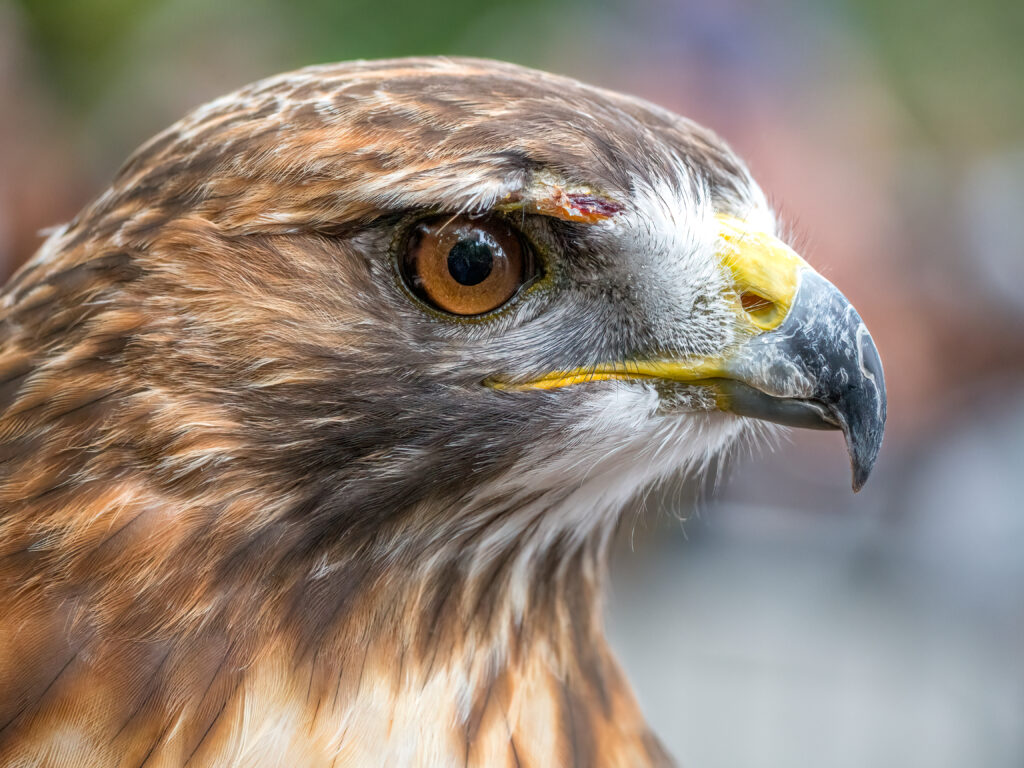
The Red-tailed Hawk and the Swainson’s Hawk are easy to mix up. Here is how the two compare across every fact we track — size, range, family and status.
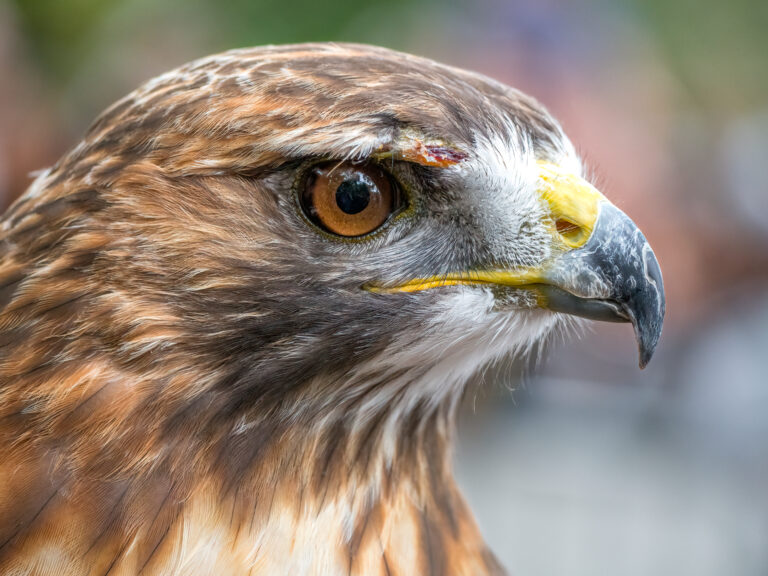 Red-tailed HawkButeo jamaicensis
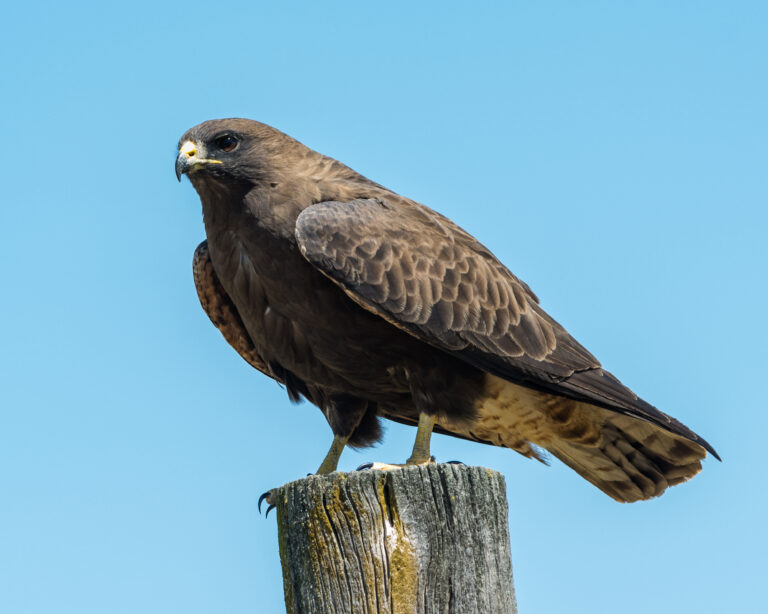 Swainson’s HawkButeo swainsoni
See the Red-tailed Hawk → See the Swainson’s Hawk →
How to tell them apart in the field
Look at the underwing and the chest: Red-tailed shows pale flight feathers with a dark patagial bar on each wing's leading edge and a white chest over a streaky dark belly band, while Swainson's shows the reverse two-toned underwing — pale wing linings against dark gray flight feathers — and a dark chest bib over a clean white belly. No other North American buteo has flight feathers as consistently dark as Swainson's.
| Field mark | Red-tailed Hawk | Swainson’s Hawk |
|---|---|---|
| Underwing pattern (flight) | Pale, whitish flight feathers in all ages and morphs, with a dark patagial bar along the leading edge of the underwing between body and wrist — a mark no similar buteo shares. | Two-toned underwing: pale wing linings contrasting sharply with dark gray flight feathers; the darkest flight feathers of any North American buteo, held even by most dark morphs. |
| Chest vs belly (light adults) | White chest with a streaky dark belly band across an otherwise pale underside — dark below the pale. | Solid rufous-brown chest bib under a white throat, with a clean whitish belly — dark above the pale, the reverse layout, giving a hooded look. |
| Wing shape and soaring posture | Broad, rounded wings; soars steadily on flattish wings or a very slight dihedral. | Long, narrow wings with pointed tips; soars with wings raised in a distinct dihedral and often teeters in the wind like a Turkey Vulture. |
| Wingtips vs tail (perched) | Folded wingtips fall noticeably short of the tail tip. | Folded wingtips reach or extend past the tail tip. |
| Tail (adults) | Uppertail brick-red to pale cinnamon-red in adults, often visible even from below as a pinkish wash. | Gray-brown tail with fine dark bands and a broader dark band near the tip; never red at any age. |
Telling females & immatures apart: Sexes look alike in both species — the trap is juveniles and dark morphs. Juvenile Red-tailed lacks the red tail and juvenile Swainson's lacks the neat chest bib (it is streaky and buffy below), so the beginner's tells for both vanish; fall back on structure and underwing. A juvenile Red-tailed still shows the dark patagial bars and belly band, and a juvenile Swainson's still shows darkish flight feathers, pointy wingtips, and folded wings reaching the tail tip. Dark-morph birds sort the same way: dark-morph Red-tailed keeps pale flight feathers, dark-morph Swainson's keeps flight feathers as dark as or darker than the wing linings.
By season, plumage or range: Plumage does not change seasonally, but range does: Swainson's Hawk is a complete long-distance migrant that winters on the pampas of South America, so from roughly November through February it is essentially absent from the US and Canada — a winter "Swainson's" deserves hard scrutiny. Red-tailed Hawks are present year-round across most of North America.
By voice: Red-tailed gives the famous hoarse, raspy, downslurred scream, "kee-eeeee-arr", lasting 2-3 seconds — the sound movies dub over eagles. Swainson's alarm scream, "kreeeeeer", is similar in length but higher-pitched, thinner, and more pure-toned or whistled, fading at the end rather than rasping.
Side by side
For plumage, calls and the finer field marks, open each bird’s full profile — every one has photos, sounds and ID notes.
More bird showdowns
- American Crow vs Northern Raven: How to Tell Them Apart
- American Goldfinch vs Pine Siskin: How to Tell Them Apart
- Bald Eagle vs Golden Eagle: How to Tell Them Apart
- Barn Swallow vs Tree Swallow: How to Tell Them Apart
- Belted Kingfisher vs Great Blue Heron: How to Tell Them Apart
- Black Vulture vs Turkey Vulture: How to Tell Them Apart
Figures are the data we hold for each species (body weight, size class, family, range and conservation status); they describe typical individuals and can vary. Plumage and voice details live on each bird’s profile.
Frequently asked questions
Is the Red-tailed Hawk bigger than the Swainson’s Hawk?
Yes — the Red-tailed Hawk is heavier, around 1.1 kg, versus about 947 g for the Swainson’s Hawk.
Are the Red-tailed Hawk and the Swainson’s Hawk related?
Yes — both are Accipitridae, so they are close relatives.
Do the Red-tailed Hawk and the Swainson’s Hawk live in the same places?
Range: both range across Central America & Caribbean and North America, so it won’t help you tell them apart.