Red-tailed Hawk vs Red-shouldered Hawk: How to Tell Them Apart
How to tell a Red-tailed Hawk from a Red-shouldered Hawk — size, range, family and status compared side by side, with links to each bird’s full ID guide.
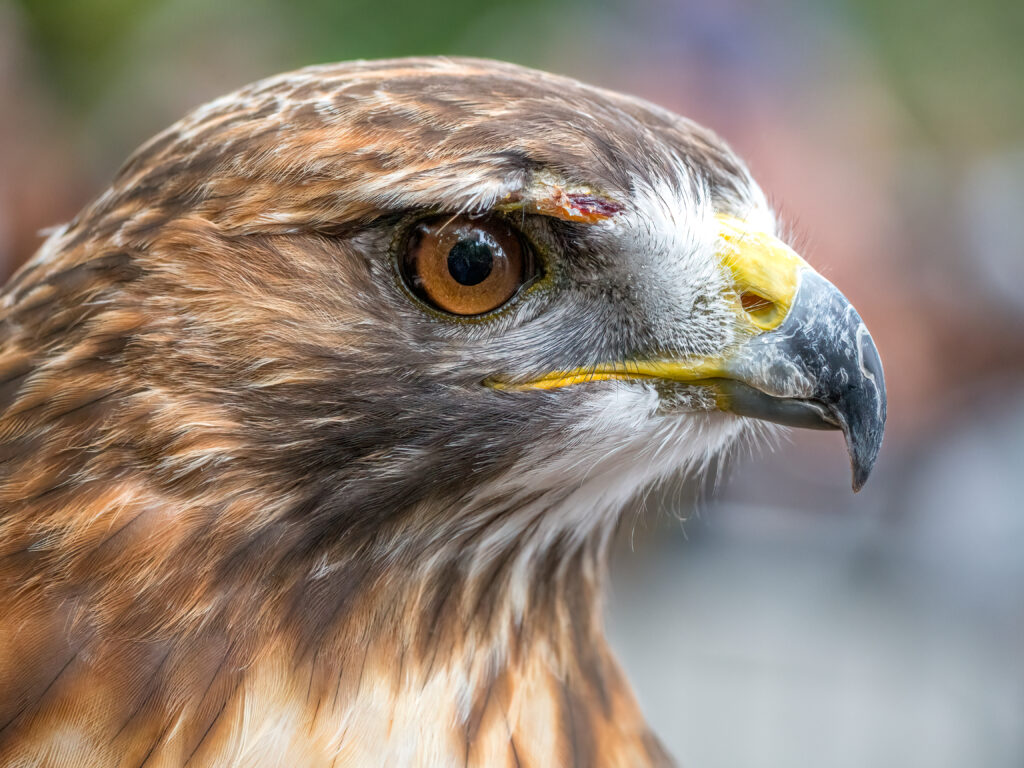
The quickest tell is size: the Red-tailed Hawk is noticeably heavier (around 1.1 kg) than the Red-shouldered Hawk (around 604 g). Here is how the two compare across every fact we track.
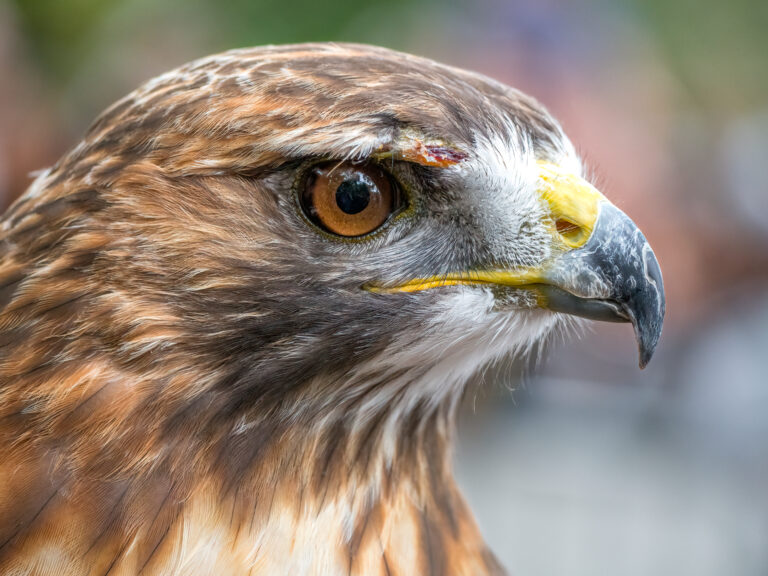 Red-tailed HawkButeo jamaicensis
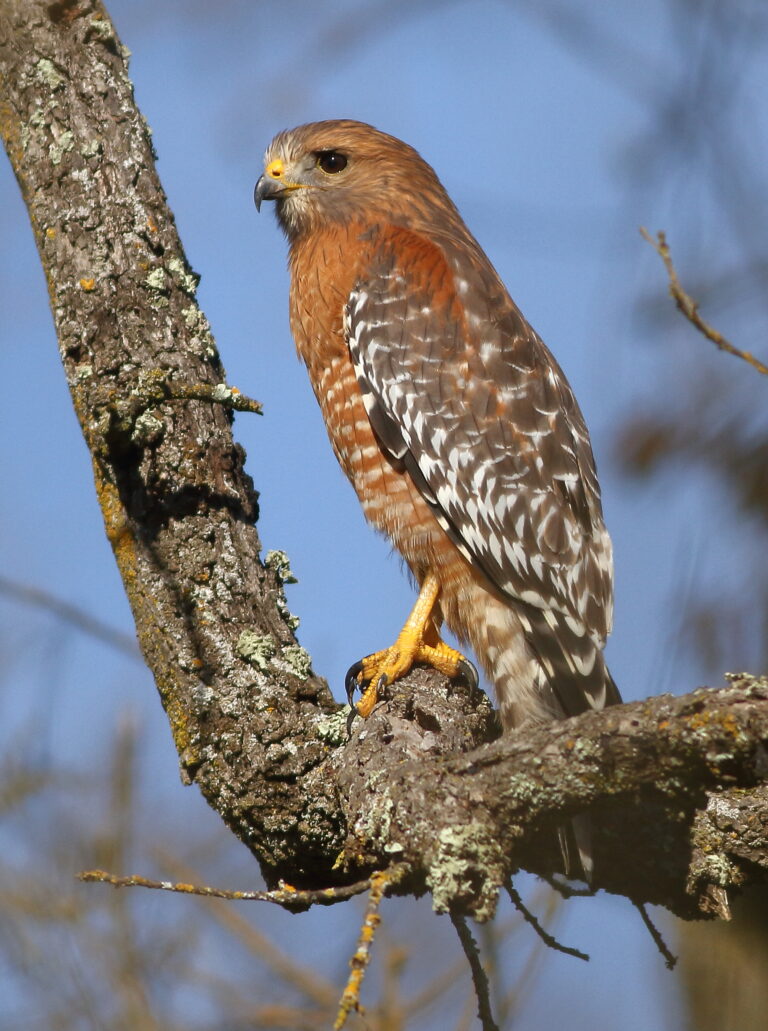 Red-shouldered HawkButeo lineatus
See the Red-tailed Hawk → See the Red-shouldered Hawk →
How to tell them apart in the field
In flight, a dark patagial bar on the leading underwing = Red-tailed; pale translucent crescents ('wing windows') at the base of the primaries = Red-shouldered. Perched, look at the tail: solid brick-red (adult Red-tailed) vs black with several narrow white bands (Red-shouldered).
| Field mark | Red-tailed Hawk | Red-shouldered Hawk |
|---|---|---|
| Underwing (flight) | Dark 'patagial bar' along the leading edge of each underwing from body to wrist — nearly 100% reliable for Red-tailed in North America | No patagial bar; instead pale, translucent crescent 'wing windows' at the base of the primaries near the wingtips, glowing when backlit (all ages) |
| Tail (adult) | Solid rufous/brick-red above with a thin dark subterminal band; no bold banding | Blackish tail crossed by several (3–4) narrow, sharply defined white bands, obvious above and below; no red in the tail at any age |
| Underparts | Pale breast with a dark 'belly band' of streaks across the MID-belly (separating a clean white upper breast from the streaked midsection; variable but usually present, strongest in eastern birds) | Warm rufous, evenly barred underparts from breast through belly (no clean pale zone, no belly band) |
| Wing shape / size | Larger, broad rounded wings; heavy, bulky buteo | Smaller, slimmer; wings look longer and more rectangular, pushed forward, held slightly bowed |
| Upperwing (perched/flight) | No rufous shoulder patch | Rufous 'red shoulder' patch on the upperwing coverts (most obvious perched); bold black-and-white checkering on the flight feathers/upperwing |
Telling females & immatures apart: Sexes look alike; the hard cases are juveniles, not females. Juvenile Red-tailed has a brown, narrowly banded tail (no red) but STILL shows the dark patagial bar — that mark carries the ID when the tail is uninformative. Juvenile Red-shouldered is browner and more streaked below but shows the pale wing-window crescents and the black-and-white flight-feather pattern.
By voice: Red-shouldered gives a loud, shrill, repeated ringing 'kee-ah, kee-ah' (delivered many times in a series, rising-then-falling, and mimicked by Blue Jays). Red-tailed gives the famous single, hoarse, raspy drawn-out scream 'keeeeer' (the 'movie eagle' sound). Where both occur, the repeated-vs-single quality is one of the fastest tells.
Side by side
For plumage, calls and the finer field marks, open each bird’s full profile — every one has photos, sounds and ID notes.
More bird showdowns
- American Crow vs Northern Raven: How to Tell Them Apart
- American Goldfinch vs Pine Siskin: How to Tell Them Apart
- Bald Eagle vs Golden Eagle: How to Tell Them Apart
- Barn Swallow vs Tree Swallow: How to Tell Them Apart
- Belted Kingfisher vs Great Blue Heron: How to Tell Them Apart
- Black Vulture vs Turkey Vulture: How to Tell Them Apart
Figures are the data we hold for each species (body weight, size class, family, range and conservation status); they describe typical individuals and can vary. Plumage and voice details live on each bird’s profile.
Frequently asked questions
Is the Red-tailed Hawk bigger than the Red-shouldered Hawk?
Yes — the Red-tailed Hawk is heavier, around 1.1 kg, versus about 604 g for the Red-shouldered Hawk.
Are the Red-tailed Hawk and the Red-shouldered Hawk related?
Yes — both are Accipitridae, so they are close relatives.
Do the Red-tailed Hawk and the Red-shouldered Hawk live in the same places?
Range: both range across Central America & Caribbean and North America, so it won’t help you tell them apart.