Blue Jay vs Steller’s Jay: How to Tell Them Apart
How to tell a Blue Jay from a Steller’s Jay — size, range, family and status compared side by side, with links to each bird’s full ID guide.
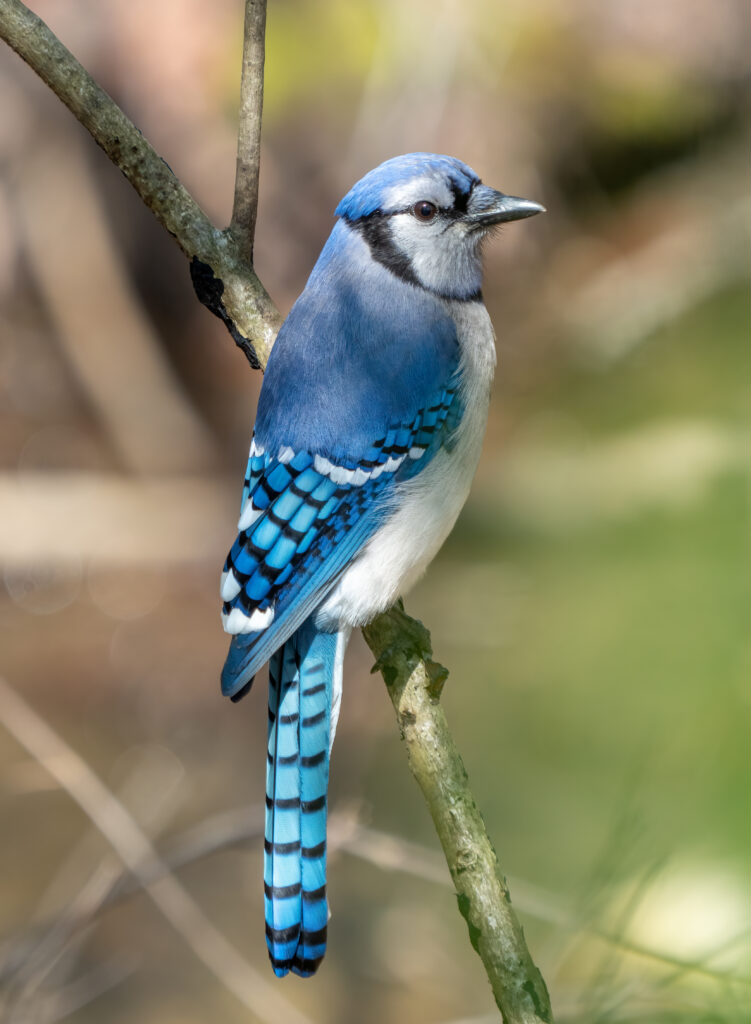
The quickest tell is size: the Steller’s Jay is noticeably heavier (around 128 g) than the Blue Jay (around 88 g). Here is how the two compare across every fact we track.
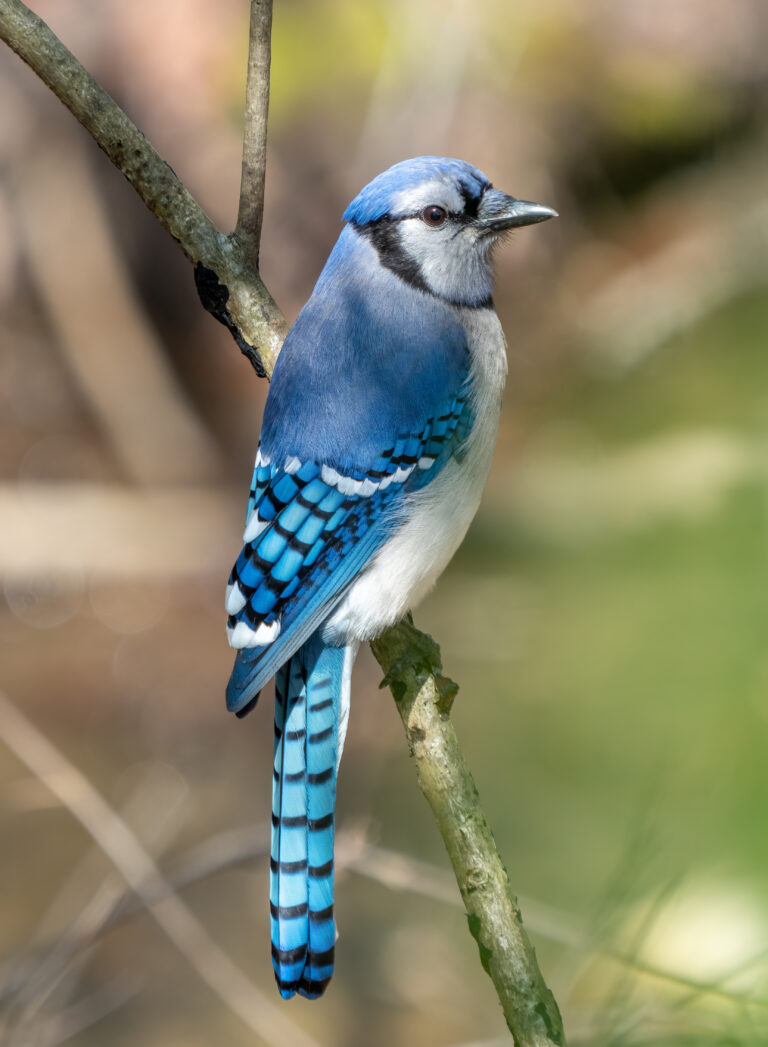 Blue JayCyanocitta cristata
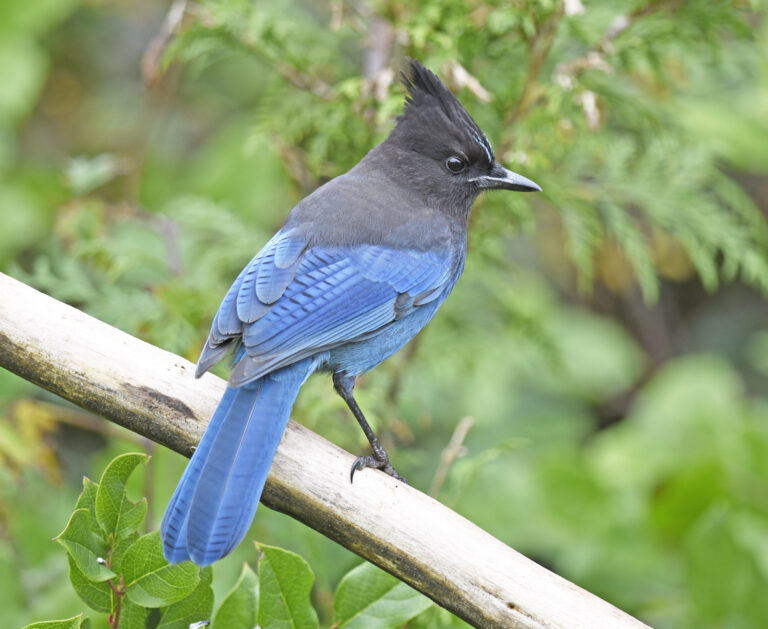 Steller’s JayCyanocitta stelleri
See the Blue Jay → See the Steller’s Jay →
How to tell them apart in the field
Look at the front half of the bird: a Blue Jay is whitish below with a pale gray-white face and a black necklace across the throat, while a Steller's Jay is sooty black from crest to mid-chest, grading into deep blue with no white anywhere below. Confirm on the wings and tail — Blue Jay flashes bold white wingbars and white tail corners; Steller's is solid blue with fine black barring and zero white.
| Field mark | Blue Jay | Steller’s Jay |
|---|---|---|
| Head, crest, and chest | Blue crest over a whitish face; pale gray-white underparts with a black necklace circling the throat and up around the nape | Sooty-black crest, head, and chest grading into deep blue on the belly and rear; no white below, no necklace |
| White in wings and tail | Bold white wingbars, white patches in the secondaries, and white outer tail corners that flash in flight | No white anywhere — wings and tail solid blue with fine blackish barring |
| Face and forehead marks | White face with a thin black bridle running through and behind the eye into the necklace | Thin streaks on the black forehead and over the eye — white on interior/Rocky Mountain birds, blue on Pacific-coast birds (faint or absent in the far west) |
| Overall tone at a glance | Reads as a bright blue-and-white bird — light chest is the first thing you notice | Reads as a dark bird — half charcoal, half deep blue, noticeably darker than any Blue Jay |
| Range and habitat | East of the Rockies in oak woods, towns, and suburbs; now a regular in Front Range cities and riparian corridors | Western conifer and pine-oak forests, typically 3,000-10,000 ft (and lower in Pacific coastal foothills); campgrounds and evergreen-country feeders |
Telling females & immatures apart: Sexes are alike and juveniles are simply duller versions of adults in both species, so age and sex are not the trap here. The real trap is the occasional Steller's x Blue Jay hybrid where the ranges meet along the Rocky Mountain foothills (especially Colorado): a bird with a dark head and white eyebrow stripe but a paler, Blue Jay-like belly and some white in the wings or tail is likely a hybrid, not a weird individual of either species.
By season, plumage or range: The two species mostly meet in fall and winter: young Blue Jays disperse westward along riparian corridors after the breeding season, and Steller's Jays drift downslope out of high conifer forest into foothill towns and feeders — so a side-by-side comparison at a Front Range feeder is far more likely from October through March than in summer.
By voice: Blue Jay gives a loud, harsh "jeer! jeer!" plus a musical, squeaky "queedle-queedle" (the "pumphandle" call); Steller's Jay gives a drier, harsher repeated "shook shook shook shook" or "SHACK-sheck-sheck-sheck". Voice supports the ID, but do not rely on hawk screams — Blue Jays expertly imitate Red-shouldered Hawks, and Steller's Jays imitate Red-tailed Hawks.
Side by side
For plumage, calls and the finer field marks, open each bird’s full profile — every one has photos, sounds and ID notes.
More bird showdowns
- American Crow vs Northern Raven: How to Tell Them Apart
- American Goldfinch vs Pine Siskin: How to Tell Them Apart
- Bald Eagle vs Golden Eagle: How to Tell Them Apart
- Barn Swallow vs Tree Swallow: How to Tell Them Apart
- Belted Kingfisher vs Great Blue Heron: How to Tell Them Apart
- Black Vulture vs Turkey Vulture: How to Tell Them Apart
Figures are the data we hold for each species (body weight, size class, family, range and conservation status); they describe typical individuals and can vary. Plumage and voice details live on each bird’s profile.
Frequently asked questions
Is the Steller’s Jay bigger than the Blue Jay?
Yes — the Steller’s Jay is heavier, around 128 g, versus about 88 g for the Blue Jay.
Are the Blue Jay and the Steller’s Jay related?
Yes — both are Corvidae, so they are close relatives.
Do the Blue Jay and the Steller’s Jay live in the same places?
Range: their ranges overlap in North America.