Cackling Goose vs Canada Goose: How to Tell Them Apart
How to tell a Cackling Goose from a Canada Goose — size, range, family and status compared side by side, with links to each bird’s full ID guide.
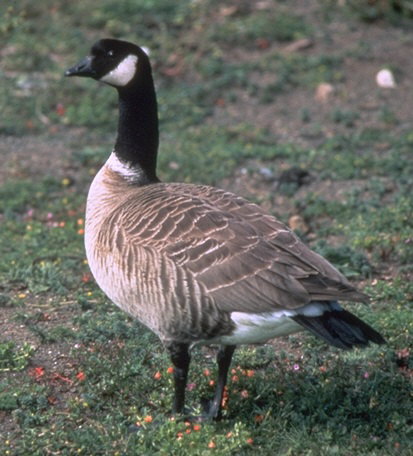
The Cackling Goose and the Canada Goose are easy to mix up. Here is how the two compare across every fact we track — size, range, family and status.
Cackling GooseBranta hutchinsii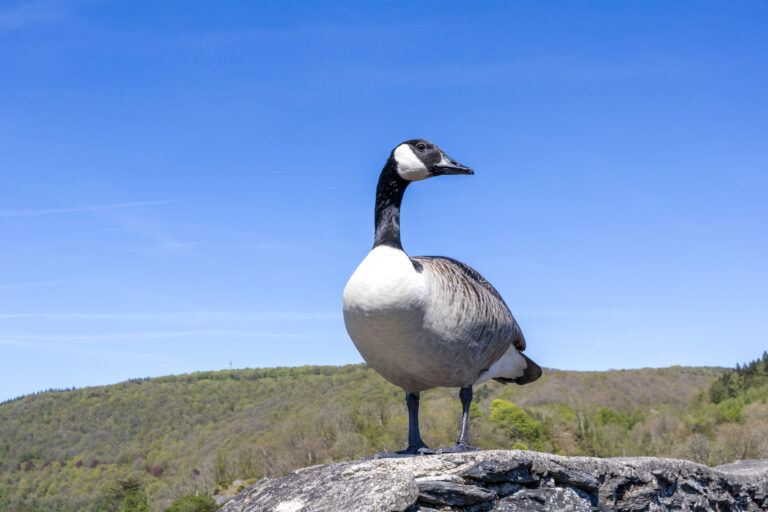 Canada GooseBranta canadensis
See the Cackling Goose → See the Canada Goose →
How to tell them apart in the field
Judge structure, not just size: Cackling is small with a short stubby triangular bill, steep forehead, blocky rounded head and short neck; Canada is larger with a longer sloping bill and long neck.
| Field mark | Cackling Goose | Canada Goose |
|---|---|---|
| Bill | Short, stubby, triangular; head length is roughly 2x the bill length | Longer, more sloping bill; head length only about 1.5x the bill length |
| Head/forehead | Rounded or squared head with a steep, near-vertical forehead rising abruptly from the bill | More sloping, wedge-shaped forehead with a smooth bill-to-forehead transition |
| Neck | Short, stocky neck (strikingly short-necked in flight) | Long, graceful neck |
| Size | Small; some barely larger than a Mallard | Large; the biggest birds can weigh roughly twice a Cackling |
| Voice | High-pitched squeaks, yips and cackles; lacks the deep honk | Deep, resonant two-note honk |
By season, plumage or range: Both retain the black neck-sock and white cheek year-round, so plumage rarely separates them; lean on structure. Beware overlap between the smallest Canada subspecies (parvipes) and largest Cackling subspecies; distant or lone birds may be safest left unidentified.
By voice: Cackling gives higher-pitched, yelping/squeaky notes and cackles; Canada gives a deep, resonant two-note honk. A high squeaky yelp among honking geese is a strong Cackling flag.
Side by side
For plumage, calls and the finer field marks, open each bird’s full profile — every one has photos, sounds and ID notes.
More bird showdowns
- American Crow vs Northern Raven: How to Tell Them Apart
- American Goldfinch vs Pine Siskin: How to Tell Them Apart
- Bald Eagle vs Golden Eagle: How to Tell Them Apart
- Barn Swallow vs Tree Swallow: How to Tell Them Apart
- Belted Kingfisher vs Great Blue Heron: How to Tell Them Apart
- Black Vulture vs Turkey Vulture: How to Tell Them Apart
Figures are the data we hold for each species (body weight, size class, family, range and conservation status); they describe typical individuals and can vary. Plumage and voice details live on each bird’s profile.
Frequently asked questions
Is the Cackling Goose bigger than the Canada Goose?
They are a similar size — both weigh around 2.8 kg.
Are the Cackling Goose and the Canada Goose related?
Yes — both are Anatidae, so they are close relatives.
Do the Cackling Goose and the Canada Goose live in the same places?
Range: their ranges overlap in North America.