Common Grackle vs Common Starling: How to Tell Them Apart
How to tell a Common Grackle from a Common Starling — size, range, family and status compared side by side, with links to each bird’s full ID guide.
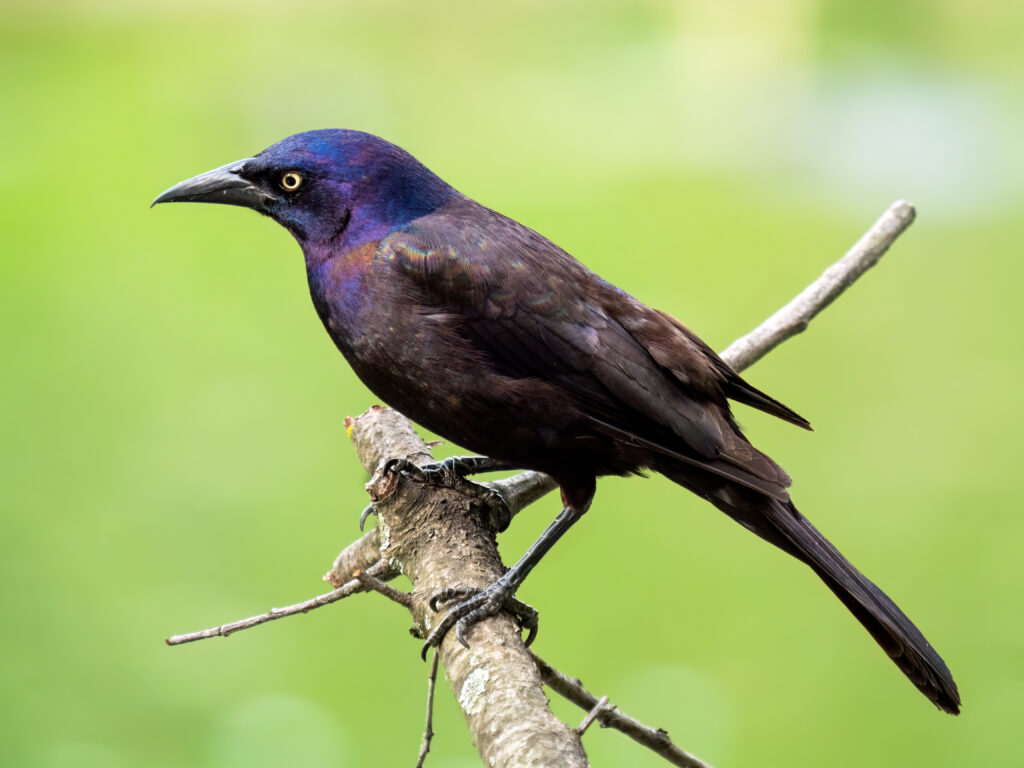
The quickest tell is size: the Common Grackle is noticeably heavier (around 105 g) than the Common Starling (around 77.1 g). Here is how the two compare across every fact we track.
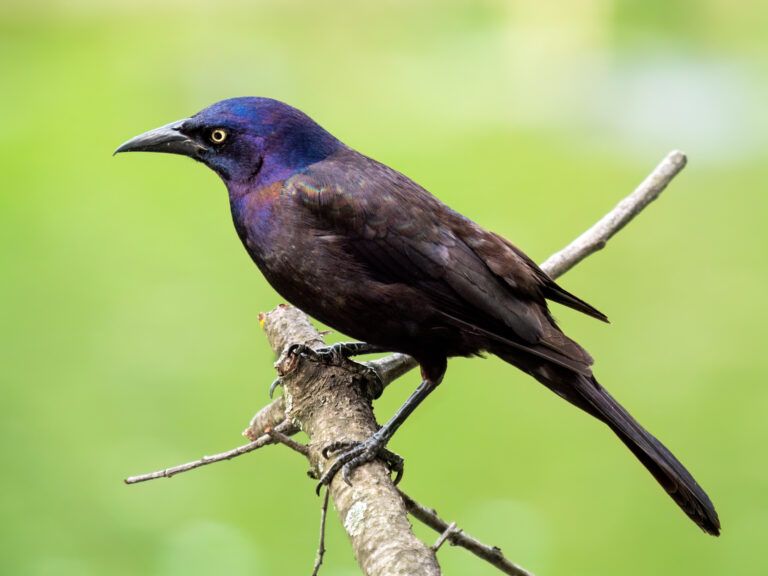 Common GrackleQuiscalus quiscula
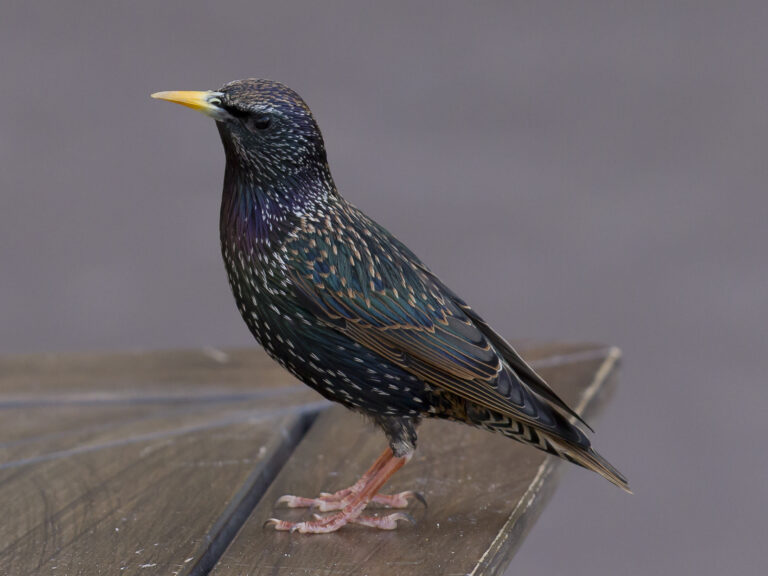 Common StarlingSturnus vulgaris
See the Common Grackle → See the Common Starling →
How to tell them apart in the field
Shape settles it: the grackle is a long-tailed, long-legged, pale-eyed blackbird; the starling is a stubby, short-tailed 'flying cigar' with a dark eye and (in summer) a yellow bill.
| Field mark | Common Grackle | Common Starling |
|---|---|---|
| Tail | Long, keel-shaped tail; bird looks stretched-out and lanky, wings look short next to the tail | Short, square tail; body looks stubby and the wings look triangular/pointed in flight |
| Eye | Pale yellow (golden) eye standing out on a dark head | Dark eye |
| Bill | Dark bill year-round; long and slender with a slight downcurve (longer than most blackbirds') | Yellow in breeding season, turns dark in winter; long, thin and straight (spiky-looking) |
| Plumage / iridescence | Solid glossy iridescence and never spotted — bronzy body contrasting a blue-purple head (bronzed form; southeastern purple form shows more even purple-green gloss) | Winter birds heavily spangled with white/buff spots; breeding birds glossy green-purple with only fine pale flecks |
| Legs | Dark gray/black legs | Pink legs |
| Size / build | Larger and lankier — long legs and long tail give a stretched silhouette | Smaller and chunky — compact, big-headed, short-tailed |
Telling females & immatures apart: Female grackles are smaller, browner and less glossy with a shorter tail than males, but still show the pale yellow eye, dark bill and dark legs — so eye colour and leg colour remain reliable against a starling. Starlings are not strongly sexually dimorphic; juvenile starlings are plain gray-brown with a dark bill and can be told from a female grackle by the short tail, dark eye and pink legs.
By season, plumage or range: Starlings look most grackle-like in winter, when the bill goes dark and the plumage is at its most speckled; even then, separate them by the short square tail, dark eye and pink legs. In summer the yellow bill and unspotted glossy plumage make the starling obvious, while the grackle's pale eye, dark bill and long keeled tail hold constant year-round.
Side by side
For plumage, calls and the finer field marks, open each bird’s full profile — every one has photos, sounds and ID notes.
More bird showdowns
- American Crow vs Northern Raven: How to Tell Them Apart
- American Goldfinch vs Pine Siskin: How to Tell Them Apart
- Bald Eagle vs Golden Eagle: How to Tell Them Apart
- Barn Swallow vs Tree Swallow: How to Tell Them Apart
- Belted Kingfisher vs Great Blue Heron: How to Tell Them Apart
- Black Vulture vs Turkey Vulture: How to Tell Them Apart
Figures are the data we hold for each species (body weight, size class, family, range and conservation status); they describe typical individuals and can vary. Plumage and voice details live on each bird’s profile.
Frequently asked questions
Is the Common Grackle bigger than the Common Starling?
Yes — the Common Grackle is heavier, around 105 g, versus about 77.1 g for the Common Starling.
Are the Common Grackle and the Common Starling related?
Not closely — the Common Grackle is a Icteridae while the Common Starling is a Sturnidae.
Do the Common Grackle and the Common Starling live in the same places?
Range: the Common Grackle is recorded in North America, the Common Starling in Europe & Northern Asia.