Song Sparrow vs House Sparrow: How to Tell Them Apart
How to tell a Song Sparrow from a House Sparrow — size, range, family and status compared side by side, with links to each bird’s full ID guide.
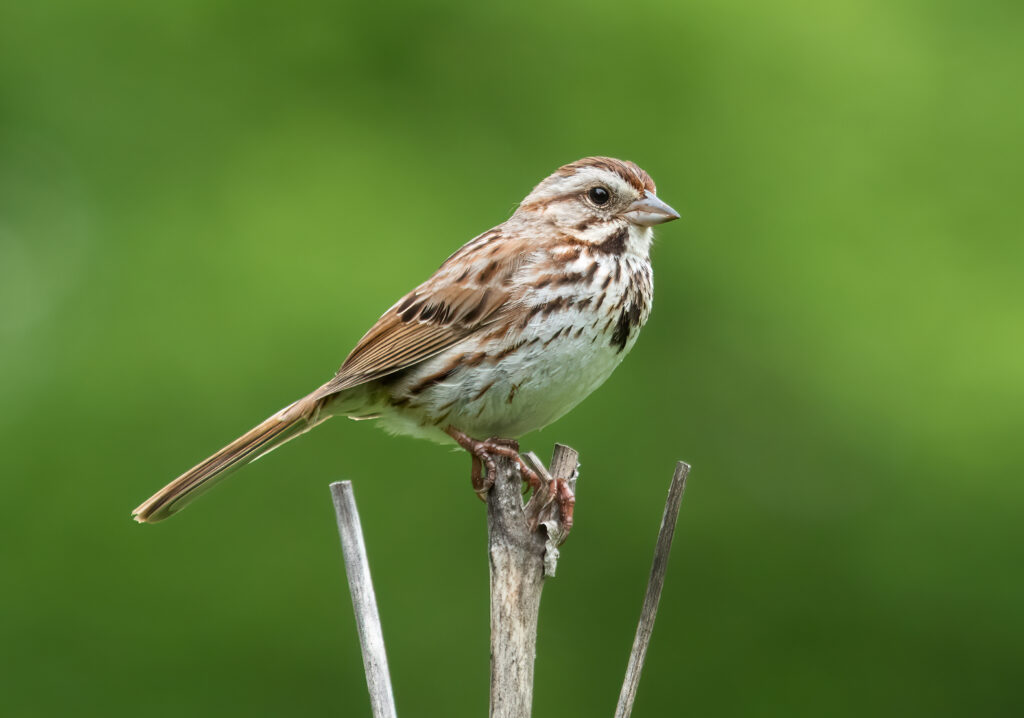
The quickest tell is size: the House Sparrow is noticeably heavier (around 26.5 g) than the Song Sparrow (around 21.9 g). Here is how the two compare across every fact we track.
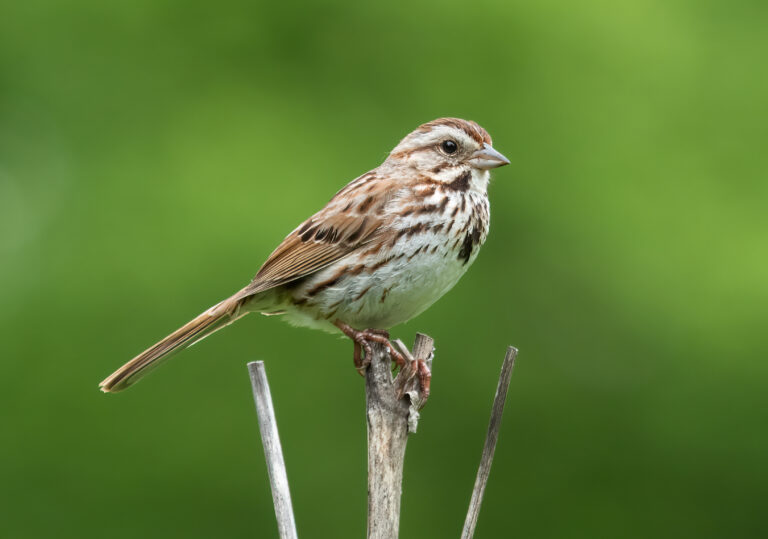 Song SparrowMelospiza melodia
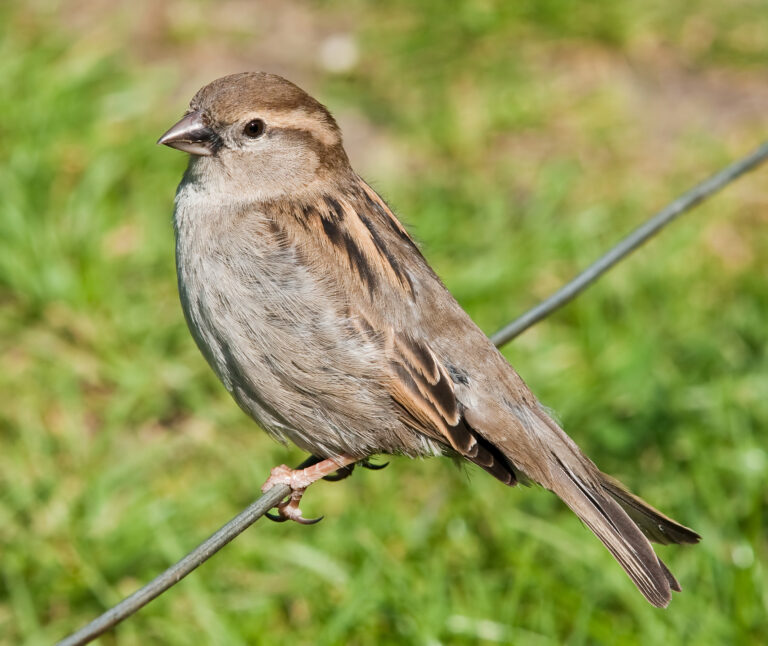 House SparrowPasser domesticus
See the Song Sparrow → See the House Sparrow →
How to tell them apart in the field
Look at the breast first: a Song Sparrow is coarsely streaked below, with the streaks converging into a dark central breast spot, while a House Sparrow is never streaked underneath — the male shows a solid black bib, the female a plain dingy gray-buff chest. Then check the bill: the House Sparrow's is conspicuously thick and stout; the Song Sparrow's is slimmer and more pointed.
| Field mark | Song Sparrow | House Sparrow |
|---|---|---|
| Breast | White-to-grayish underparts with coarse dark brown streaks that converge into a dark central breast spot | Never streaked below: breeding male has a solid black bib on throat and upper chest; female and nonbreeding birds plain dingy gray-buff |
| Bill | Modest, fairly slim conical sparrow bill, brownish-horn colored | Oversized, thick-based stout bill — black on breeding males, yellowish on females and nonbreeding birds |
| Head pattern | Russet crown stripes split by a pale gray central stripe, broad gray eyebrow, russet line through the eye, and thick dark malar (mustache) stripes framing the pale throat | Male: gray crown, chestnut sweeping from behind the eye to the nape, whitish cheek, black bib; female: plain face with a single broad buffy eyebrow behind the eye and no malar stripes |
| Tail and flight | Long, rounded tail pumped downward during short, fluttering flights | Shorter plain brown tail held straight; direct flight with no tail-pumping |
| Habitat and company | Skulks low in brushy, often wet edges and thickets, usually alone or in pairs, popping up to sing from an exposed perch | Chattering flocks around buildings, eaves, parking lots, and feeders — rarely far from human structures |
Telling females & immatures apart: The trap is the female or nonbreeding House Sparrow, which lacks the male's black bib and gray-and-chestnut head: she is plain buffy-brown with an unstreaked dingy chest, a striped buff-and-black back, and one broad buffy eyebrow behind the eye. No Song Sparrow of any age is plain-breasted — even juvenile Song Sparrows (buffier, with finer, blurrier streaking) still show streaked underparts and the striped face with malar stripes.
By season, plumage or range: In fresh fall plumage the male House Sparrow's black bib is partly veiled by pale gray feather tips and his bill turns yellowish; the pale tips wear away over winter, revealing the full black bib and black bill by spring. Song Sparrows look essentially the same year-round.
By voice: Song Sparrow sings a bright, structured song — two or three short clear opening notes followed by a jumble ending in a buzz or trill, classically transliterated "Maids! Maids! Maids! put on your tea-kettle-ettle-ettle" — and gives a distinctive husky "chimp" call. House Sparrow has no comparable song: just simple "cheep" and "chirrup" notes repeated monotonously, often by a whole chattering flock at once.
Side by side
For plumage, calls and the finer field marks, open each bird’s full profile — every one has photos, sounds and ID notes.
More bird showdowns
- American Crow vs Northern Raven: How to Tell Them Apart
- American Goldfinch vs Pine Siskin: How to Tell Them Apart
- Bald Eagle vs Golden Eagle: How to Tell Them Apart
- Barn Swallow vs Tree Swallow: How to Tell Them Apart
- Belted Kingfisher vs Great Blue Heron: How to Tell Them Apart
- Black Vulture vs Turkey Vulture: How to Tell Them Apart
Figures are the data we hold for each species (body weight, size class, family, range and conservation status); they describe typical individuals and can vary. Plumage and voice details live on each bird’s profile.
Frequently asked questions
Is the House Sparrow bigger than the Song Sparrow?
Yes — the House Sparrow is heavier, around 26.5 g, versus about 21.9 g for the Song Sparrow.
Are the Song Sparrow and the House Sparrow related?
Not closely — the Song Sparrow is a Passerellidae while the House Sparrow is a Passeridae.
Do the Song Sparrow and the House Sparrow live in the same places?
Range: the Song Sparrow is recorded in North America, the House Sparrow in Africa, Europe & Northern Asia and South & Southeast Asia.