Mourning Dove vs Rock Dove: How to Tell Them Apart
How to tell a Mourning Dove from a Rock Dove — size, range, family and status compared side by side, with links to each bird’s full ID guide.
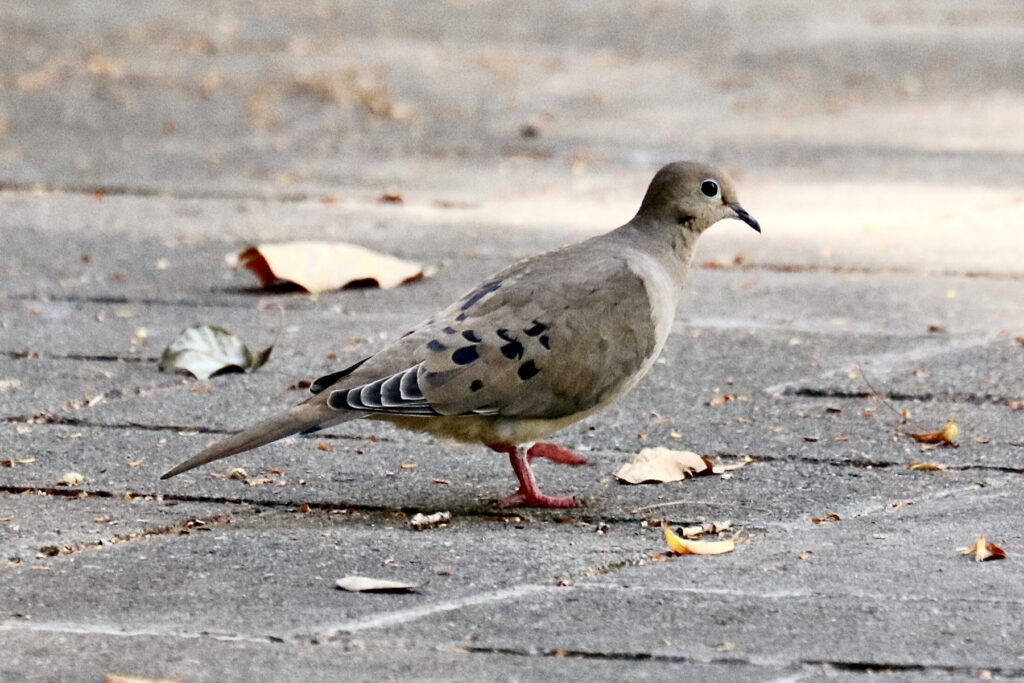
The quickest tell is size: the Rock Dove is noticeably heavier (around 354 g) than the Mourning Dove (around 119 g). Here is how the two compare across every fact we track.
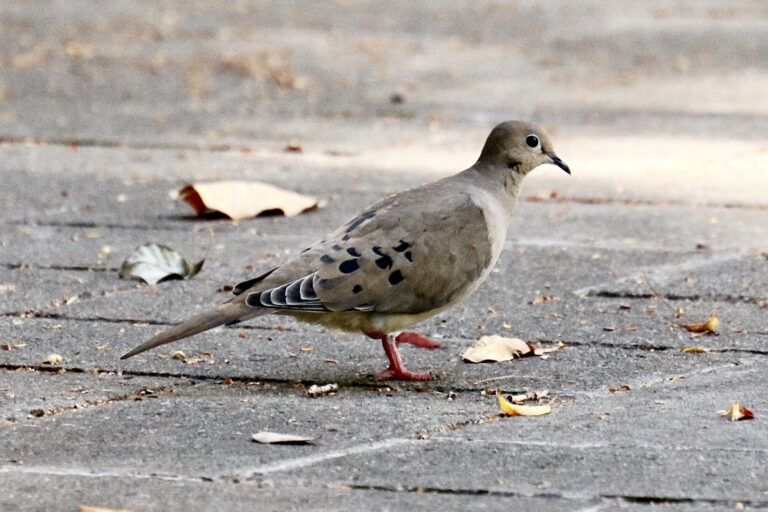 Mourning DoveZenaida macroura
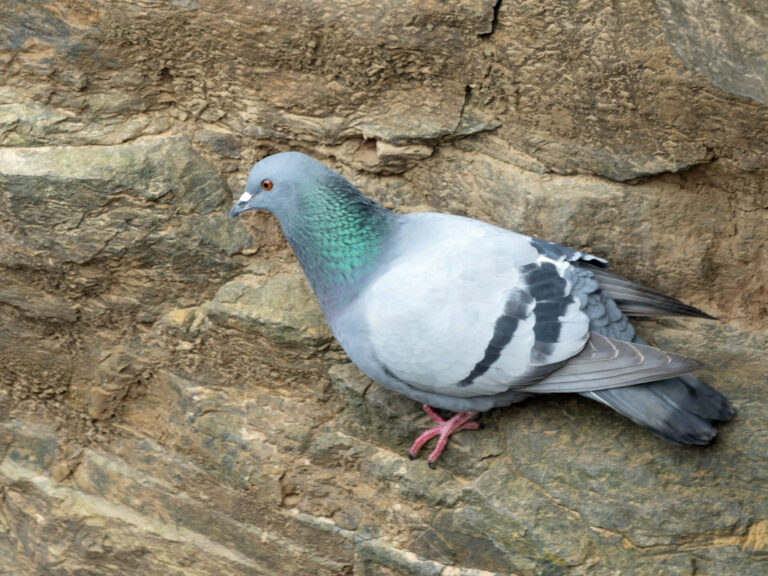 Rock DoveColumba livia
See the Mourning Dove → See the Rock Dove →
How to tell them apart in the field
Check the tail and the build first: a Mourning Dove is a slim, small-headed bird with a long, tapered, point-tipped tail edged in white, while a Rock Pigeon is a bulky, deep-chested bird with a short, broad, square-cut tail that usually ends in a dark band. If it flushes, listen for the whistle: a Mourning Dove's wings whistle sharply on takeoff, a sound Rock Pigeon wings never make — both species can clap their wings, so it is the whistle, not the clap, that settles it.
| Field mark | Mourning Dove | Rock Dove |
|---|---|---|
| Tail shape and tip | Long, tapered tail that narrows to a point, with white tips on the outer feathers that flash as white edges in flight | Short, broad, square- or fan-shaped tail, usually ending in a dark terminal band |
| Size and build | Slender and delicate, with a small round head on a thin neck; only about a third of a Rock Pigeon's weight | Bulky and deep-chested with a proportionally larger, blockier body; nearly three times a Mourning Dove's weight and noticeably broader-winged |
| Wing pattern (perched) | Plain soft buffy-brown to grayish wings marked with scattered large black spots on the folded wing | Classic blue-bar birds show two crisp black bars across a gray wing — but morphs vary (checkered, rusty, pied, near-white), so bars can be absent |
| Neck and bill | Plain buffy-tan head with only a faint pinkish sheen on the neck, a small dark crescent below the ear, and a thin, straight dark bill | Bold green-and-purple iridescent sheen over the whole neck and a heavier bill with a prominent whitish cere at its base |
| Takeoff sound | Wings produce a sharp, musical whistling or whinnying on takeoff and landing — a sound Rock Pigeon wings never make | Wingtips often clap together loudly on takeoff with no whistle — but a clap alone proves nothing, since Mourning Doves can clap their wings too |
Telling females & immatures apart: Sexes are nearly alike in both species, so the real traps are age and morph. A juvenile Mourning Dove looks scaly, darker, and shorter-tailed than an adult — chunky enough to suggest a small pigeon — but keeps the thin bill, wing spotting, and a pointed (if stubby) tail. On the other side, Rock Pigeons come in endless color morphs (checkered, red-barred, pied, near-white, all-dark), so never call this pair on color alone: the two wing bars can be missing entirely, while build and tail shape always hold.
By season, plumage or range: Neither species changes plumage with the seasons; the seasonal difference is movement. Rock Pigeons are strict year-round residents, while Mourning Doves are partial migrants that largely withdraw from southern Canada and the coldest northern edge of their range in winter — though they remain common through winter across most of the U.S.
By voice: Mourning Dove sings a slow, mournful, owl-like coo — "coo-OO-oo, oo, oo" — soft enough that beginners often report a daytime owl. Rock Pigeon gives a throaty, rolling gurgle, "coo, roo-c'too-coo," with none of the mournful whistled quality.
Side by side
For plumage, calls and the finer field marks, open each bird’s full profile — every one has photos, sounds and ID notes.
More bird showdowns
- American Crow vs Northern Raven: How to Tell Them Apart
- American Goldfinch vs Pine Siskin: How to Tell Them Apart
- Bald Eagle vs Golden Eagle: How to Tell Them Apart
- Barn Swallow vs Tree Swallow: How to Tell Them Apart
- Belted Kingfisher vs Great Blue Heron: How to Tell Them Apart
- Black Vulture vs Turkey Vulture: How to Tell Them Apart
Figures are the data we hold for each species (body weight, size class, family, range and conservation status); they describe typical individuals and can vary. Plumage and voice details live on each bird’s profile.
Frequently asked questions
Is the Rock Dove bigger than the Mourning Dove?
Yes — the Rock Dove is heavier, around 354 g, versus about 119 g for the Mourning Dove.
Are the Mourning Dove and the Rock Dove related?
Yes — both are Columbidae, so they are close relatives.
Do the Mourning Dove and the Rock Dove live in the same places?
Range: their ranges overlap in Central America & Caribbean and North America.