Red-winged Blackbird vs Brewer’s Blackbird: How to Tell Them Apart
How to tell a Red-winged Blackbird from a Brewer’s Blackbird — size, range, family and status compared side by side, with links to each bird’s full ID guide.
The quickest tell is size: the Brewer’s Blackbird is noticeably heavier (around 62.5 g) than the Red-winged Blackbird (around 50.8 g). Here is how the two compare across every fact we track.
Red-winged BlackbirdAgelaius phoeniceus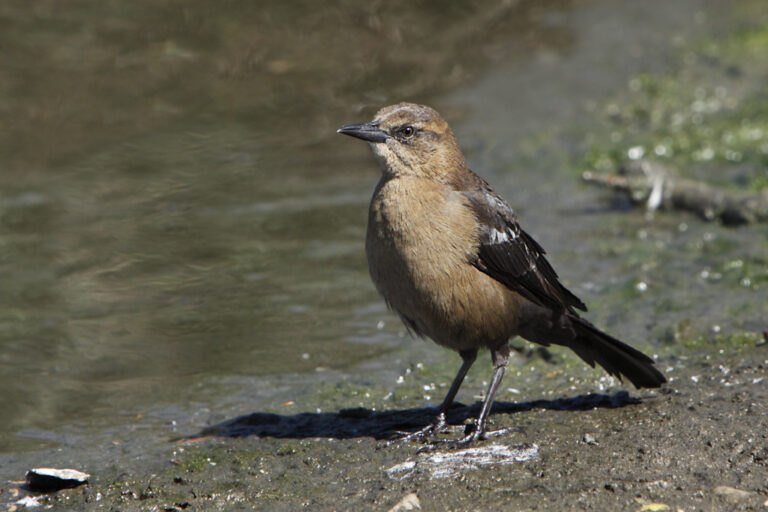 Brewer’s BlackbirdEuphagus cyanocephalus
See the Red-winged Blackbird → See the Brewer’s Blackbird →
How to tell them apart in the field
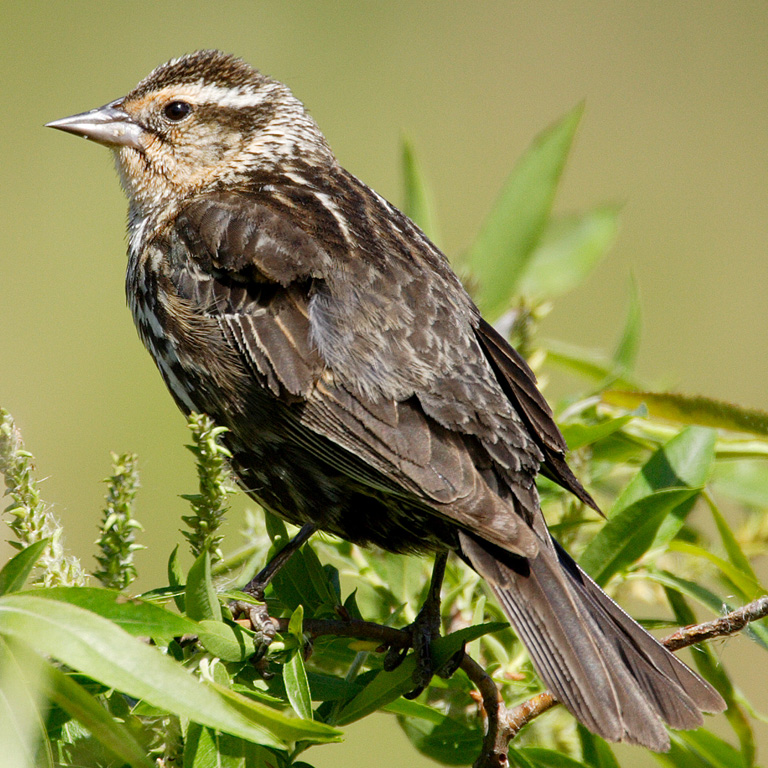
Males are instant: Red-winged shows a red shoulder patch bordered in yellow (at minimum a thin yellowish shoulder line when the red is tucked away), while Brewer's is uniformly glossy black with a staring yellow-white eye and no wing patch at all. For brown birds, heavily streaked means female Red-winged; plain, unstreaked gray-brown with a dark eye means female Brewer's.
| Field mark | Red-winged Blackbird | Brewer’s Blackbird |
|---|---|---|
| Shoulder patch (males) | Red epaulet bordered yellow on the wing shoulder; even when body feathers conceal the red, a pale yellowish edge usually shows as a thin line along the folded wing | No wing patch of any kind — wing is the same glossy black as the body |
| Eye color (males) | Dark eye that disappears into the black head | Piercing pale yellow-white eye that stands out at long range (female Brewer's has a dark eye) |
| Female plumage | Heavily streaked brown above and below, sparrow-like, with a pale whitish-buff eyebrow stripe | Plain, unstreaked dull gray-brown overall — no streaks, no eyebrow contrast |
| Habitat and behavior | Ties to wet, brushy cover — cattail marshes, ditches, hayfields; males sing from an exposed high perch with epaulets flared | Bird of bare open ground — lawns, sidewalks, parking lots, feedlots; walks with short forward jerks of the head while foraging |
| Sheen and head profile (sunlit males) | Even glossy black but without strong iridescence — no purple or green sheen — with a sharply pointed conical bill and flattish crown giving a spike-billed profile | Strongly iridescent in sun — purple sheen on the head grading to greenish gloss on the body — with a rounder head and a straight bill |
Telling females & immatures apart: This pair's trap is the brown birds. Female Red-winged is so heavily streaked it is routinely mistaken for a big sparrow; female Brewer's is the opposite — a smooth, unmarked gray-brown bird with a dark eye and no eyebrow stripe. If your brown blackbird is streaky with a pale eyebrow, it is a Red-winged; if it is plain and blank-faced, think Brewer's. Immature male Red-wingeds add confusion: female-like and streaky in fall, then blackish with rusty feather edging and muted orange-red epaulets — but any hint of a shoulder patch rules out Brewer's.
By season, plumage or range: In fall and winter flocks, male Red-wingeds often keep the red epaulet almost fully concealed, showing only the narrow yellowish border — do not wait for a red flash before calling it. The "bicolored" Red-winged of central and coastal California lacks the yellow border entirely. Brewer's males look the same year-round, but the purple-and-green gloss needs sunlight; in flat light they read as plain black, leaving the yellow eye as the tell.
By voice: Red-winged's song is the famous gurgling "conk-la-ree!" ending in a musical trill, plus a flat "check" call. Brewer's has nothing so musical: a short, creaky, rising "squee" — often written "que-ee" or "k-seee" — and an unmusical rushing gurgle, plus a dry "chuk" call. (The "rusty hinge" song belongs to Rusty Blackbird, not Brewer's.) If it sings conk-la-ree, it is a Red-winged, period.
Side by side
For plumage, calls and the finer field marks, open each bird’s full profile — every one has photos, sounds and ID notes.
More bird showdowns
- American Crow vs Northern Raven: How to Tell Them Apart
- American Goldfinch vs Pine Siskin: How to Tell Them Apart
- Bald Eagle vs Golden Eagle: How to Tell Them Apart
- Barn Swallow vs Tree Swallow: How to Tell Them Apart
- Belted Kingfisher vs Great Blue Heron: How to Tell Them Apart
- Black Vulture vs Turkey Vulture: How to Tell Them Apart
Figures are the data we hold for each species (body weight, size class, family, range and conservation status); they describe typical individuals and can vary. Plumage and voice details live on each bird’s profile.
Frequently asked questions
Is the Brewer’s Blackbird bigger than the Red-winged Blackbird?
Yes — the Brewer’s Blackbird is heavier, around 62.5 g, versus about 50.8 g for the Red-winged Blackbird.
Are the Red-winged Blackbird and the Brewer’s Blackbird related?
Yes — both are Icteridae, so they are close relatives.
Do the Red-winged Blackbird and the Brewer’s Blackbird live in the same places?
Range: their ranges overlap in North America.