Great Blue Heron vs Sandhill Crane: How to Tell Them Apart
How to tell a Great Blue Heron from a Sandhill Crane — size, range, family and status compared side by side, with links to each bird’s full ID guide.
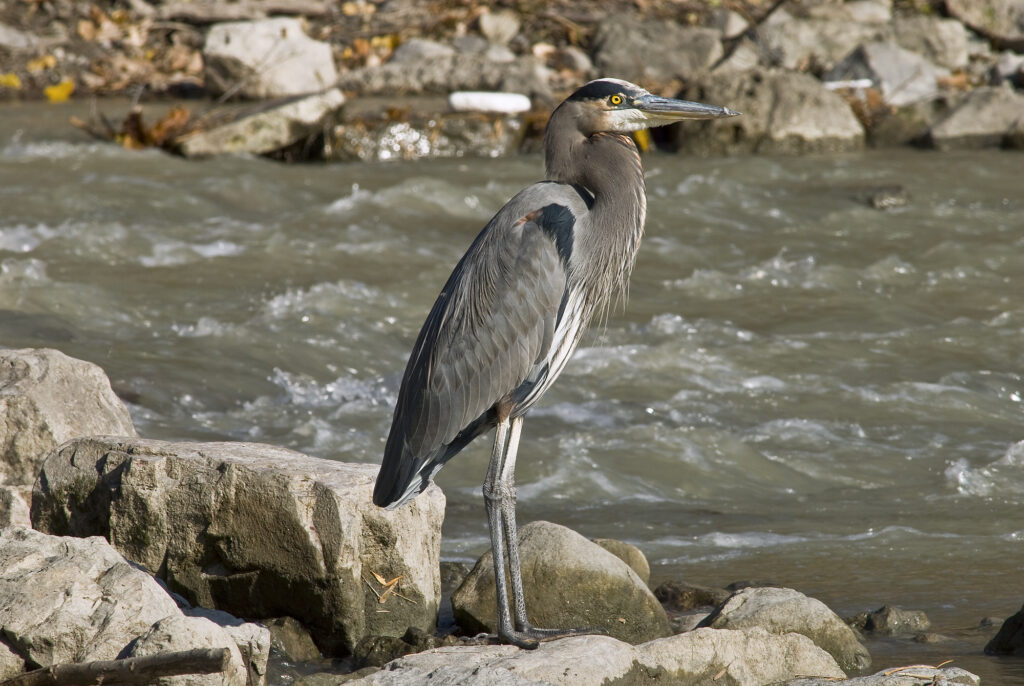
The quickest tell is size: the Sandhill Crane is noticeably heavier (around 4.3 kg) than the Great Blue Heron (around 2.5 kg). Here is how the two compare across every fact we track.
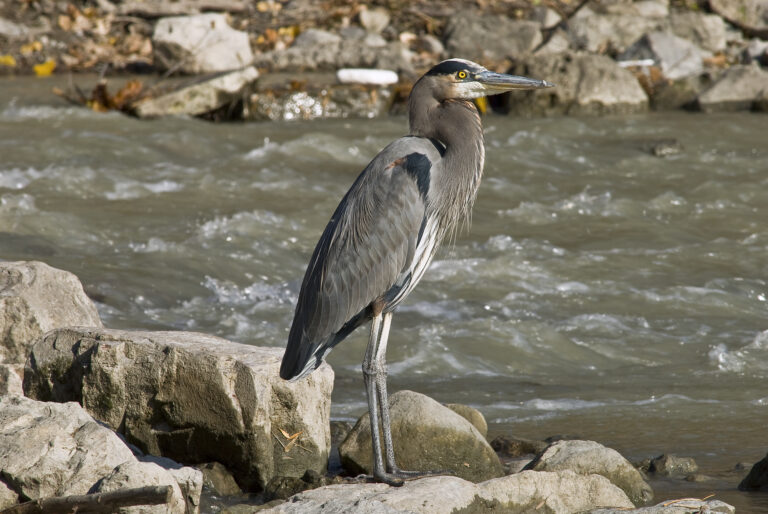 Great Blue HeronArdea herodias
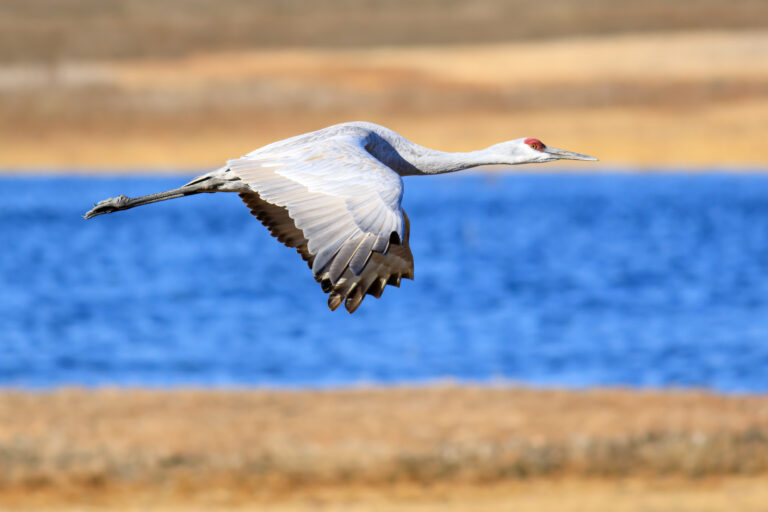 Sandhill CraneAntigone canadensis
See the Great Blue Heron → See the Sandhill Crane →
How to tell them apart in the field
In flight the ID is instant: a Great Blue Heron pulls its neck into a tight S with the head drawn back against the shoulders, while a Sandhill Crane flies with the neck fully outstretched like a goose. On the ground, check head and rear: the crane shows a bare red crown, pale cheek, and a bushy feather "bustle" drooping over the tail; the heron has a whitish face with a black stripe over the eye, a heavy yellow-orange dagger bill, and a smooth rear that tapers to a point.
| Field mark | Great Blue Heron | Sandhill Crane |
|---|---|---|
| Neck in flight | Neck folded into a tight S-curve, head drawn back to rest against the shoulders, so the flying bird looks front-heavy and short-necked; legs trail behind | Neck held fully outstretched, straight out in front like a goose; legs also trail behind |
| Head pattern (adult) | Whitish face and crown crossed by a wide black stripe over the eye that extends into black head plumes | Bare red skin on the forecrown and a clean pale/white cheek; no black stripe, no plumes |
| Rear end | Smooth, sleek rear — the folded wings and tail taper to a point | Bushy 'bustle' of long, drooping, curved feathers hanging over the short tail |
| Bill | Very long, heavy, dagger-like bill, yellowish to orange | Noticeably shorter, straight, dark gray bill |
| Wingbeats | Slow, deep, heavy wingbeats on broad wings bowed downward | Quicker, stiffer wingbeats with a distinctive snappy flick on the upstroke; wings held flatter |
| Habitat and behavior | Usually alone, standing motionless or wading slowly in shallow water; readily perches and nests in trees | Walks steadily across open fields, prairies, and marsh edges while foraging, often in pairs or large flocks; almost never perches in trees |
Telling females & immatures apart: Sexes look alike in both species; the real trap is the juvenile Sandhill Crane, which lacks both the red crown and the pale cheek and is washed rusty brown overall — so crown-based ID fails. Fall back on structure: the bustle over the tail, the shorter dark bill, and the fully outstretched neck in flight still say crane. Immature Great Blue Herons are also duller, with a solid dark crown and no head plumes, but they keep the heron's dagger bill and folded S-neck in flight.
By season, plumage or range: In spring and summer many Sandhill Cranes preen iron-rich mud into their feathers and look rusty brown rather than slate gray — don't let the rusty wash throw you; the red crown and bustle still hold. Great Blue Heron plumage looks much the same year-round.
By voice: Voice is a strong tell for this pair. Great Blue Heron gives a deep, hoarse, croaking squawk — "frahnk!" — usually when flushed, and is mostly silent in flight. Sandhill Crane gives a loud, rolling, rattling bugle — "gar-oo-oo" with a trilled r — that carries up to 2.5 miles and is given constantly in flight; a noisy, bugling flock overhead is cranes, not herons.
Side by side
For plumage, calls and the finer field marks, open each bird’s full profile — every one has photos, sounds and ID notes.
More bird showdowns
- American Crow vs Northern Raven: How to Tell Them Apart
- American Goldfinch vs Pine Siskin: How to Tell Them Apart
- Bald Eagle vs Golden Eagle: How to Tell Them Apart
- Barn Swallow vs Tree Swallow: How to Tell Them Apart
- Belted Kingfisher vs Great Blue Heron: How to Tell Them Apart
- Black Vulture vs Turkey Vulture: How to Tell Them Apart
Figures are the data we hold for each species (body weight, size class, family, range and conservation status); they describe typical individuals and can vary. Plumage and voice details live on each bird’s profile.
Frequently asked questions
Is the Sandhill Crane bigger than the Great Blue Heron?
Yes — the Sandhill Crane is heavier, around 4.3 kg, versus about 2.5 kg for the Great Blue Heron.
Are the Great Blue Heron and the Sandhill Crane related?
Not closely — the Great Blue Heron is a Ardeidae while the Sandhill Crane is a Gruidae.
Do the Great Blue Heron and the Sandhill Crane live in the same places?
Range: their ranges overlap in North America.