Mallard vs American Black Duck: How to Tell Them Apart
How to tell a Mallard from a American Black Duck — size, range, family and status compared side by side, with links to each bird’s full ID guide.

The Mallard and the American Black Duck are easy to mix up. Here is how the two compare across every fact we track — size, range, family and status.
 MallardAnas platyrhynchos
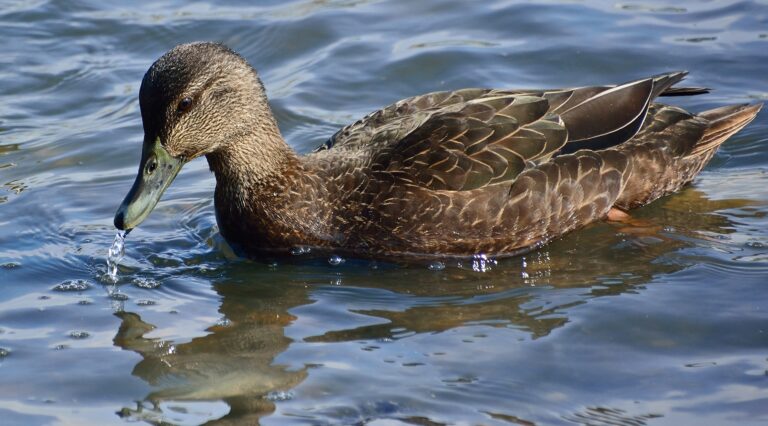 American Black DuckAnas rubripes
See the Mallard → See the American Black Duck →
How to tell them apart in the field
Quickest tell: the flashing silvery-white underwings against a near-black body, plus a speculum bordered black-only (no white bars) on the Black Duck vs the female Mallard's bold white speculum bars and paler, warmer body.
| Field mark | Mallard | American Black Duck |
|---|---|---|
| Body color | Uniformly paler, warmer mottled-brown; little head/body contrast | Very dark, blackish chocolate-brown body contrasting sharply with a pale grayish head/neck (strongly two-toned) |
| Speculum borders | Blue speculum framed by bold white bars both top and bottom | Iridescent purple-violet speculum bordered by black only — no white bars (a thin white trailing edge at most) |
| Bill color | Female: orange bill blotched with black. Male: solid yellow | Male: dull greenish-yellow (olive) bill. Female: duller drab olive, often dusky |
| Underwing in flight | Paler body gives far less underwing contrast | Flashing silvery-white underwings contrasting strongly with the dark body — the classic, striking in-flight mark |
Telling females & immatures apart: The hard case is female/eclipse Mallard vs Black Duck. Separate by speculum borders (bold white bars = Mallard; black-only = Black Duck), the much darker body with pale gray head on Black Duck, and bill (orange-and-black = female Mallard; drab olive = Black Duck). Beware hybrids (common in the northeast): they show intermediate speculum borders, a greenish head sheen, and brown feathering in the underwing lining where a pure Black Duck's is clean silvery-white.
Side by side
For plumage, calls and the finer field marks, open each bird’s full profile — every one has photos, sounds and ID notes.
More bird showdowns
- American Crow vs Northern Raven: How to Tell Them Apart
- American Goldfinch vs Pine Siskin: How to Tell Them Apart
- Bald Eagle vs Golden Eagle: How to Tell Them Apart
- Barn Swallow vs Tree Swallow: How to Tell Them Apart
- Belted Kingfisher vs Great Blue Heron: How to Tell Them Apart
- Black Vulture vs Turkey Vulture: How to Tell Them Apart
Figures are the data we hold for each species (body weight, size class, family, range and conservation status); they describe typical individuals and can vary. Plumage and voice details live on each bird’s profile.
Frequently asked questions
Is the American Black Duck bigger than the Mallard?
Yes — the American Black Duck is heavier, around 1.2 kg, versus about 720–1580 g for the Mallard.
Are the Mallard and the American Black Duck related?
Yes — both are Anatidae, so they are close relatives.
Do the Mallard and the American Black Duck live in the same places?
Range: their ranges overlap in North America.